.png "H96 Max Android TV Box video reviews and tutorials on YouTube")
.png "H96 Max Android TV Box photos and lifestyle shots on Instagram")



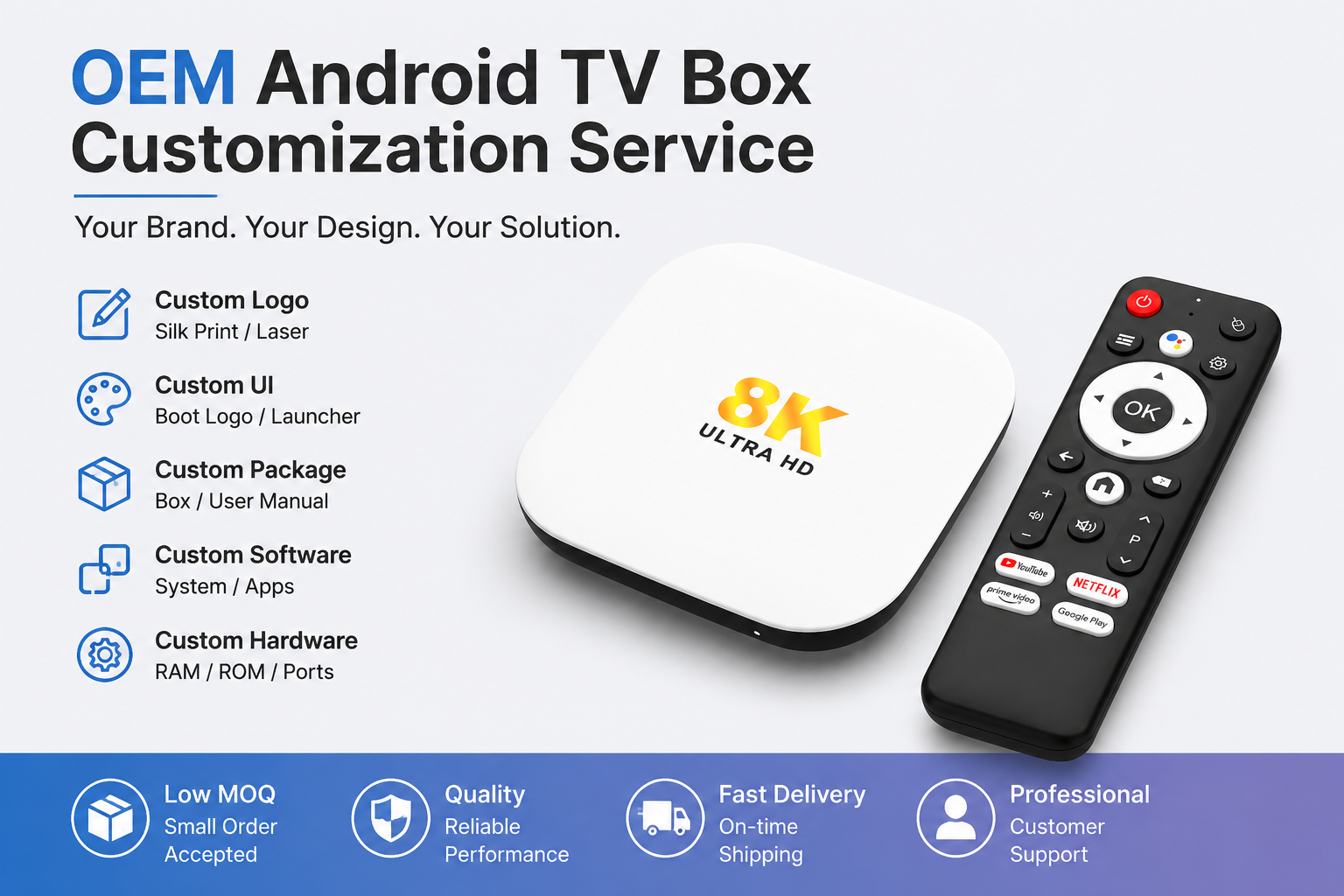
Designing a Software Experience That Feels Branded, Intuitive, and Scalable
Custom Smart TV Box projects succeed or fail less because of hardware than because of software experience. In connected entertainment, hospitality, operator services, and commercial display, users rarely talk about RAM size or storage after setup. They remember how fast the device boots, how clear the interface feels, whether the remote works, how easily they find content, and whether updates improve or break the experience. For brands, software customization is therefore not decoration added at the end. It is a commercial tool that shapes product identity, service adoption, support cost, and loyalty. A well-planned Custom Smart TV Box should be designed around system behavior, UI logic, and lifecycle control from the first stage of development.
Connected screens now sit inside a wider digital ecosystem. Users move across apps and services with patience for friction. If a device feels generic or confusing, trust drops quickly. A clean experience can improve retention and recurring revenue. That is why global buyers focus on Android customization, launcher design, app strategy, OTA planning, and service integration when defining the device roadmap.
Why System and UI Customization Matter More Than Many Buyers Expect
Many procurement teams assume hardware creates most of the differentiation in a streaming device. In reality, hardware only creates potential. Software determines how that potential is experienced. Two devices with similar chipsets can feel completely different because their launcher behavior, startup flow, app arrangement, navigation logic, and update stability are different. For a Custom Smart TV Box, UI and system customization directly influence activation, perceived quality, and support volume after deployment.
This matters even more in B2B projects. Telecom operators may need account-first onboarding. Hospitality integrators may need restricted access and centrally managed applications. Retail brands may prioritize a distinctive home screen, while enterprise deployments may focus on controlled permissions. In each case, a Custom Smart TV Box using a default interface without adaptation misses a chance to support the real business objective.
Start with User Journey Mapping, Not Visual Decoration
The most common mistake in UI customization is to start with colors, icons, and logo placement before defining what the user is supposed to do. Strong software projects begin by mapping the journey from power-on to regular use. What appears on the first screen? Does the customer sign in, activate a service, choose a language, or go directly to content? How many steps stand between unboxing and value delivery? The answers shape the interface architecture.
A capable Custom Smart TV Box Manufacturer should help buyers translate business goals into journey logic. A device built for subscription activation may need a shorter path to account verification. A box for shared environments may need locked settings and auto-recovery logic. A Private Label Smart TV Box aimed at retail may need a home screen that makes branded content feel immediately accessible. The UI should guide behavior that supports the commercial model.
Android System Customization: The Layer Beneath the Interface
System customization involves much more than changing wallpapers or icons. It includes launcher behavior, boot animation, default language, input handling, preloaded applications, key mapping, update permissions, recovery logic, and the interaction between system services and foreground apps. These choices define whether a Custom Smart TV Box feels polished or unfinished.
At this stage, buyers should decide how much control they need over the Android experience. Some projects require a structured launcher with fixed content entry points. Others need a lighter interface that leaves room for multiple third-party services. Some want to hide system complexity from end users. Others want a more open experience that resembles a standard entertainment device. A credible OEM Smart TV Box Supplier should explain what can be changed at the framework level, what belongs to the launcher layer, and what may affect system stability, app compatibility, or update maintenance.
Long-term governance matters too. A device that launches with a customized UI but lacks disciplined version control becomes difficult to maintain once apps change or bugs appear. That is why Custom Smart TV Box OEM ODM Solutions for Global Brands and IPTV Providers should be evaluated in terms of release management, regression testing, and OTA strategy rather than appearance alone.
Launcher Design, Navigation Logic, and Content Priority
The launcher is the most visible expression of device strategy. It determines what users see first, how quickly they reach key functions, and how clearly the product communicates its purpose. In a strong Custom Smart TV Box project, the launcher is designed around content hierarchy and usage habits. The most important services should be the easiest to reach, while settings remain accessible.
Navigation design has to respect remote-based interaction. What works on mobile screens may feel frustrating on television. Focus movement, menu depth, row structure, and search entry should all be optimized for lean-back use. Buyers often underestimate this when they request attractive interfaces that are awkward to operate with a remote. A serious Android TV Box Wholesale Supplier with software coordination capability will treat TV interaction as its own design language rather than copying mobile UI habits onto a large screen.
Content priority is another strategic issue. The answer depends on the channel model. Good design helps users reach value quickly.
App Strategy, Preload Decisions, and Service Integration
Application planning should be part of platform strategy. Preloading too many apps can slow the system, create clutter, and confuse first-time users. Preloading too few can make the box feel unfinished. A Custom Smart TV Box should therefore follow an app policy based on use case, region, and business value. Core services should be easy to access, while lower-priority tools should not compete for attention on the home screen.
Integration quality matters as much as app count. Buyers should consider account linking, deep-link behavior, playback compatibility, search visibility, and update responsibility. For operator and IPTV projects, middleware alignment can matter more than app variety. For a Private Label Smart TV Box, the goal is often to make the device feel like a coherent service environment rather than a collection of unrelated applications.
This is one reason companies search for How to Choose a Reliable Custom Smart TV Box Manufacturer for Your Business. They need a partner that can coordinate software dependencies, app testing, firmware version control, and deployment timing across multiple teams. Without that discipline, even a good interface concept can become unstable in mass deployment.
Localization, OTA Updates, and Post-Launch Experience Control
A device intended for global or regional distribution must be designed for localization from the beginning. Language switching, fonts, time zones, keyboard input, legal screens, help content, and onboarding copy all influence whether the experience feels market-ready. Localization is not only about translation. It affects trust. A device that uses awkward wording or incomplete regional adaptation can feel unreliable even when the hardware is strong.
OTA planning is equally important. Updates should improve stability, add value, and fix issues without creating fear around every release. Buyers need to know how builds are approved, how staged rollout works, what rollback options exist, and who owns emergency response. A disciplined Custom Smart TV Box Manufacturer treats OTA governance as part of product architecture, not as an afterthought once units are already in the field.
Post-launch analytics and issue handling should also be considered early. Brands and operators need visibility into activation problems, app crashes, navigation pain points, and update outcomes. Controlled feedback loops help teams refine the UI over time.
Balancing Differentiation, Stability, and Development Cost
Not every project needs the deepest possible software customization. The right level depends on timeline, market maturity, internal resources, and commercial objectives. Some buyers benefit from a mostly standard Android base with branded launcher adjustments. Others need deeper integration across provisioning, middleware, account flow, and interface logic. The key is to avoid customization that adds engineering cost without strengthening the business model.
That is where an experienced OEM Smart TV Box Supplier adds value. A good partner helps the buyer identify which software changes improve usability, retention, conversion, or brand distinction, and which changes simply create maintenance burden. A successful Custom Smart TV Box program is the one where every change has a clear commercial purpose.
What Buyers Should Check Before Approving a Customized UI
Before launch, teams should review more than design mockups. They should test boot behavior, remote navigation, language switching, application startup, network recovery, search visibility, settings access, OTA prompts, and error handling under realistic conditions. They should confirm what happens if a service fails, a user skips onboarding, or a network drops during activation. These moments often shape customer perception more strongly than polished homepage graphics.
Buyers should also ask who owns future iteration. Will the interface be updated after launch? How quickly can bugs be fixed? These questions separate a one-time customization exercise from a sustainable device strategy.
Final Perspective
Android system and UI customization give brands, operators, and solution providers the opportunity to turn a generic device into a purposeful experience. When user journey mapping, launcher design, app integration, localization, OTA governance, and support are handled well, the product becomes easier to use, easier to support, and better aligned with revenue goals. H96 Max, as a source factory with experience in hardware integration, software coordination, private-label projects, and scalable B2B production, can help buyers define the right software scope and execute it responsibly. For companies planning a differentiated device roadmap, the next step is to align product goals with a partner that can manage both experience design and manufacturing delivery. Partner with H96 Max today.
READ MORE
How to Choose a Reliable Smart TV Box ODM Manufacturer for Long-Term Partnership
Smart TV Box ODM Cost Breakdown: How to Control Budget and Maximize ROI
How Custom Smart TV Boxes Help Operators and Brands Increase Revenue
One-Stop Smart TV Box ODM Solutions: Hardware, Software and Branding Integration
Smart TV Box Certification Guide: Google TV, Netflix, CE, FCC and Global Compliance
Smart TV Box Hardware Customization Guide: CPU, RAM, Storage and Design Options
From Concept to Mass Production: Complete Smart TV Box ODM Development Process
OEM vs ODM Smart TV Box: Which Business Model Is Better for Your Brand?
Custom Smart TV Box Explained: Why Global Brands Choose OEM/ODM Solutions
Quick Links

.png "Watch H96 Max Android TV Box reviews on our YouTube channel")

.png "Explore H96 Max product photos on Instagram")