.png "H96 Max Android TV Box video reviews and tutorials on YouTube")
.png "H96 Max Android TV Box photos and lifestyle shots on Instagram")



How to Build an OTT Box Wholesale Program Without Sacrificing Quality
An OTT TV Box Manufacturer becomes more important when a buyer moves from one purchase order to a repeat wholesale program. In a single order, the buyer mainly worries about price, shipment, and whether the sample works. In a wholesale program, the buyer must protect reorder consistency, reseller trust, support cost, stock rotation, and long-term product positioning. The market is large enough to reward disciplined buyers. Grand View Research estimated the over-the-top devices and services market at USD 298.84 billion in 2024, and streaming adoption continues to expand across connected households worldwide. The opportunity is real, but wholesale success depends on repeatable execution.
Wholesale is not just volume buying
Many importers think wholesale means negotiating a lower unit price. In reality, wholesale means building a product system that can be sold repeatedly without creating hidden service costs. A distributor needs stable models, clear packaging, predictable lead times, accessory availability, and a supplier that can respond when the market changes. An OTT TV Box Manufacturer that only focuses on winning the first bulk order may not be prepared for this kind of responsibility.
Wholesale buyers should define the sales channel before choosing the configuration. Will the product go to online resellers, regional shops, installers, hotel projects, or telecom partners? Each channel needs different support. Online resellers need accurate product information and low complaint rates. Installers need quick setup and reliable accessories. Operators need firmware control and possibly remote management. A wholesale program fails when one generic device is forced into too many different situations.
The first strategic question is not “How cheap can this be?” It is “Can this product be reordered with the same user experience?” A serious OTT TV Box Supplier will help answer that question through component control, firmware documentation, packaging consistency, and after-sales planning.
Choose a core model strategy
A wholesale program should avoid unnecessary model chaos. Too many similar models confuse resellers, complicate inventory, and make support more difficult. Buyers should create a clear structure: an entry model, a mainstream model, and possibly a premium model if the channel can support it. Each model should have a reason to exist. The entry model protects price-sensitive demand. The mainstream model protects margin and user satisfaction. The premium model supports brand differentiation.
A capable OTT TV Box Manufacturer can help buyers decide which specifications matter for each tier. The entry model may focus on stable playback and basic apps. The mainstream model may need stronger Wi-Fi, better remote quality, and more storage. The premium model may justify improved industrial design, voice remote, advanced codec support, or custom launcher work. The point is not to maximize specifications; the point is to match each model to a sales promise.
This approach also improves purchasing leverage. When buyers concentrate volume into fewer controlled models, they can negotiate better component stability, packaging support, and production scheduling. The factory can plan materials more efficiently, and the buyer can market the line more clearly.
Lock the details that affect repeat orders
In wholesale, the second order matters as much as the first. Resellers expect repeat units to feel the same. If the remote changes, the packaging looks different, or the firmware interface shifts, customers may suspect the product is inconsistent. A professional OTT TV Box Manufacturer should help lock the important details before launch.
The controlled list should include chipset, RAM, storage, Wi-Fi module, Bluetooth, remote type, power adapter, housing color, packaging artwork, barcode, manual, firmware version, app list, launcher settings, boot logo, and carton marks. Buyers should also define which parts can be substituted and which require approval. Without this discipline, the factory may make practical changes that seem small but create channel confusion.
A strong OTT TV Box Factory should retain reference samples. One unit stays with the factory, and one stays with the buyer. If a future batch is questioned, both sides can compare against the approved reference. This simple practice reduces disputes and improves accountability.
Use firmware to reduce support cost
Wholesale buyers often underestimate firmware. They may focus on hardware because it is easier to compare. Yet firmware determines the first-start experience, app organization, language settings, remote key behavior, update path, and many support questions. A box with acceptable hardware but poor firmware can still generate complaints.
A capable OTT Android Box Manufacturer should provide a stable firmware plan for wholesale buyers. Ask whether the factory can remove unnecessary apps, preload approved apps, set language defaults, customize boot logos, organize the launcher, and maintain the same build across repeat orders. Ask whether OTA support is available and how bugs are handled. Ask whether a firmware update can be tested before release.
This is especially important because users are more experienced with streaming than before. TV Technology reported Parks Associates data showing that streaming subscriptions reached 91% of U.S. internet households by late 2025. Experienced users compare devices quickly. They notice slow navigation, confusing menus, and unstable app behavior. Firmware quality is therefore not a technical luxury; it is a conversion and retention factor.
Build wholesale packaging for confidence
Packaging should make the product easier to sell and easier to support. A good retail box communicates the model clearly, avoids exaggerated claims, protects the product, and gives the reseller confidence. The manual should be simple, accurate, and matched to the firmware. The accessory list should be complete. The barcode should support warehouse management. The carton should survive export handling.
An OTT Media Box Manufacturer that understands wholesale will discuss packaging as part of the product program. Buyers should avoid printing app logos or performance claims that may create platform or marketplace risk. Packaging should be attractive but accurate. Overpromising may increase short-term clicks and long-term returns.
For private-label wholesale, packaging also protects brand memory. Resellers remember products that are easy to display, easy to explain, and easy to reorder. The visual identity should remain consistent across batches. If packaging changes frequently, the channel may feel unstable even when the hardware is acceptable.
Set inspection standards before production
Wholesale buyers should not rely on general factory QC. They should define inspection standards before production begins. The inspection checklist should include appearance, model label, firmware version, Wi-Fi, HDMI, USB, remote control, power adapter, packaging, accessory count, barcode, carton mark, and random aging test results. For higher-value orders, third-party inspection or buyer-side sampling may be appropriate.
Quality control should be connected to commercial impact. A minor scratch may matter less in a low-cost bulk market but more in a premium retail product. A manual language error may be minor in one channel and serious in another. The buyer should define the difference between critical, major, and minor defects according to sales reality.
A disciplined OTT TV Box Manufacturer can work with these standards because they create clarity. When standards are vague, every problem becomes an argument. When standards are written, both sides know what must be corrected before shipment.
Plan reorder timing and inventory risk
OTT TV Box Wholesale profit depends on availability. If a model sells well but cannot be reordered quickly, resellers may switch brands. If buyers overstock a weak model, cash flow suffers. The OTT TV Box Manufacturer relationship should include realistic lead-time planning, component availability updates, and packaging preparation schedules. A supplier that communicates early helps buyers avoid both stockouts and dead stock.
Buyers should also discuss lifecycle. How long will the chipset remain available? Are there planned changes in the housing, remote, or adapter? Can the factory support the same model for several order cycles? If not, when should the buyer prepare a replacement model? The best OTT TV Box Manufacturer does not surprise the buyer with sudden discontinuation. It helps plan transitions.
For fast-growing markets, buyers should also monitor app requirements, codec trends, Wi-Fi expectations, and regional compliance. Not every upgrade is necessary, but wholesale programs need a roadmap. A product line that never evolves can become vulnerable to competitors.
Convert wholesale buyers with reliability, not hype
Wholesalers and distributors win when they make resellers feel safe. The product does not need exaggerated promises. It needs a clear configuration, stable supply, responsive support, and a factory that understands repeat business. Resellers ask practical questions: Will the next batch be the same? Can I get spare remotes? Will customers complain? Can I reorder before stock runs out? Will the packaging still match my product listing?
Choosing an OTT TV Box Manufacturer for wholesale is therefore a business decision, not only a procurement decision. The right partner helps the buyer create a line that can scale across channels while protecting reputation. The wrong partner may provide a low first price and a long list of hidden costs.
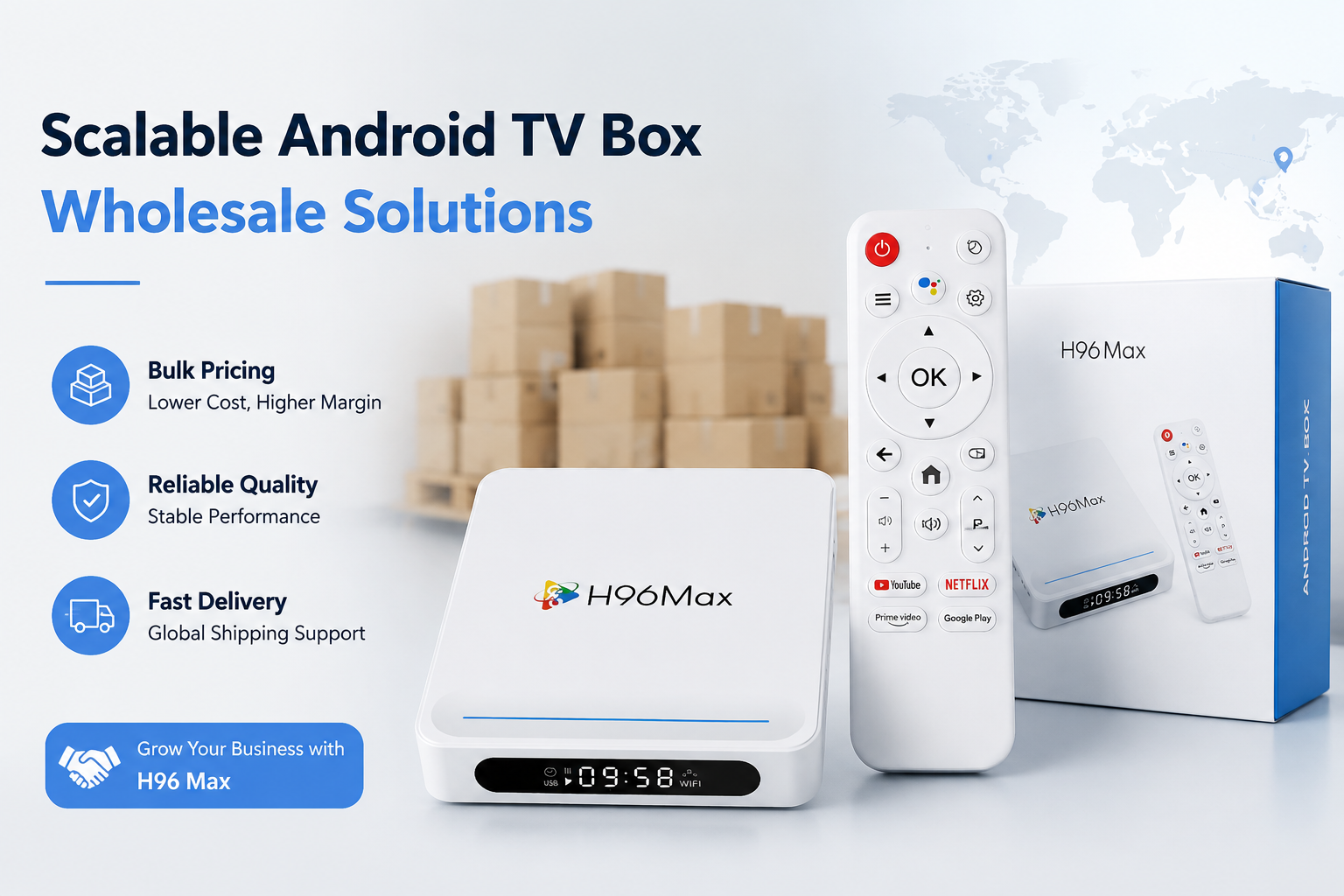
H96 Max supports global wholesale buyers with source-factory OEM/ODM Android TV box production, model planning, firmware adaptation, packaging customization, stable supply coordination, and bulk order support. If your goal is to build a wholesale product line that resellers can trust and reorder, Partner with H96 Max today and turn your TV box sourcing into a repeatable growth program.
READ MORE
Factory Audit Questions That Reveal the Right TV Box Partner
Good Samples, Bad Shipments: Avoid This OEM TV Box Sourcing Trap
How to Choose an OTT TV Box Manufacturer That Won’t Cost You the Market
Quick Links

.png "Watch H96 Max Android TV Box reviews on our YouTube channel")

.png "Explore H96 Max product photos on Instagram")