.png "H96 Max Android TV Box video reviews and tutorials on YouTube")
.png "H96 Max Android TV Box photos and lifestyle shots on Instagram")



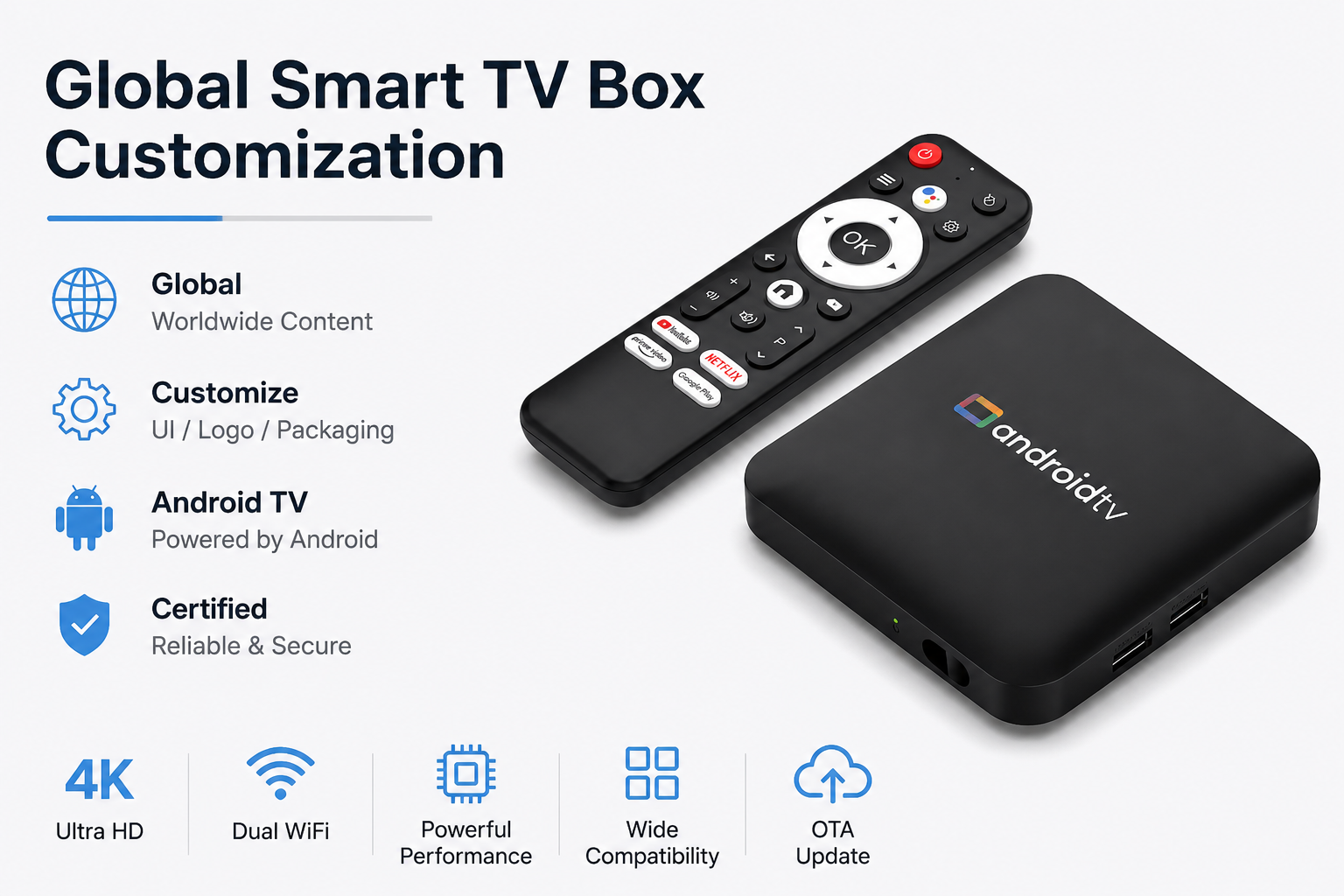
Why a Tailored Streaming Device Strategy Now Matters More Than Ever
As smart home adoption, OTT entertainment, enterprise digitalization, and commercial display demand accelerate, the Custom Smart TV Box has evolved from a basic hardware unit into a strategic endpoint that connects content delivery, brand identity, user experience, and recurring service revenue. For global buyers, the device is no longer judged only by processor speed or memory size. It is evaluated by how well it supports launch timing, software control, regulatory readiness, regional adaptation, and long-term profitability. That is why more brands, operators, retailers, and platform owners are moving away from generic boxes and toward OEM or ODM cooperation that aligns the product with business goals from the start.
The timing is not accidental. Grand View Research estimates the global smart TV market reached USD 247.0 billion in 2025 and projects continued double-digit growth through 2033, while GSMA reported that 4.6 billion people were using mobile internet by the end of 2023. IAB also says digital video is expected to account for nearly 60% of U.S. TV and video ad spend in 2025. Together, these signals show why connected screens are becoming more central to entertainment, commerce, advertising, and service delivery.
Why Standard Devices Often Fail in Real B2B Deployment
Many procurement teams begin with a practical assumption: if several vendors offer similar Android-based streaming boxes, then the lowest-cost option should be enough. In small pilots, that can appear true. In scaled deployment, however, the weaknesses of a generic product show up quickly. The device may not support the right launcher logic, middleware, DRM path, remote-control mapping, or industrial design requirements. It may also lack packaging flexibility, multilingual UI readiness, or stable firmware governance. These gaps do not always appear on the quotation sheet, but they surface later as launch delays, support tickets, returns, and repeated revision cycles.
This is why many international buyers prefer a Private Label Smart TV Box or a deeper OEM/ODM project instead of a catalog model. A product designed for retail in one market may not fit an operator bundle in another. A box optimized for living-room streaming may not fit hospitality, education, digital signage, or enterprise communication scenarios. Even when the hardware seems acceptable, software ownership becomes a pain point. Teams often discover that they cannot control boot animation, default apps, update cadence, or onboarding flow in the way their customers expect.
A serious Custom Smart TV Box program helps buyers avoid these mismatches. It gives them the opportunity to define not only chip platform and memory configuration, but also form factor, user journey, regional apps, peripheral compatibility, packaging language, and quality benchmarks. More importantly, it shifts the conversation from “what is available now” to “what outcome the business needs to achieve.”
Why Global Brands Choose OEM and ODM Instead of Pure Trading Models
The strongest reason brands choose OEM or ODM is control. In an OEM model, the buyer can bring its own brand concept, interface preferences, software logic, and commercial positioning while relying on manufacturing expertise for execution. In an ODM model, the buyer can move faster by using an existing technical platform and then customizing the parts that matter most, such as casing, UI, firmware behavior, packaging, accessory bundle, or certification scope. For many businesses, ODM is the most efficient bridge between speed and differentiation.
This matters when procurement teams are trying to balance faster market entry, lower development risk, and visible product distinction. A capable Custom Smart TV Box Manufacturer can shorten the learning curve because it already understands chipset roadmaps, thermal design constraints, PCB validation, operating system adaptation, and mass-production quality control. Instead of building those capabilities from zero, the brand invests in focused customization where it creates value.
The same logic explains why an OEM Smart TV Box Supplier is attractive to telecom operators, IPTV platforms, regional distributors, and emerging consumer electronics brands. These companies do not always need to invent the core hardware architecture from scratch. They need a dependable pathway to launch a device that fits their ecosystem, margin structure, and service model. In this context, OEM/ODM is not simply a production format. It is a business model for reducing uncertainty while preserving room for brand ownership.
Another factor is channel differentiation. When multiple sellers use nearly identical hardware with no meaningful software or visual distinction, price becomes the main competitive lever. A well-planned Custom Smart TV Box project can support a branded activation flow, preferred content entry points, device management logic, or operator-specific experience that is harder to compare directly against low-end alternatives.
The Real Procurement Pain Points Buyers Are Trying to Solve
When buyers search for “How to Choose a Reliable Custom Smart TV Box Manufacturer for Your Business,” they are usually reacting to concrete pain points. One common issue is inconsistency between prototype quality and mass-production quality. Another is weak project management, where software teams, purchasing teams, and certification teams are not aligned, causing repeated engineering changes. A third is poor communication around lead time, which creates channel tension when launch campaigns have already been scheduled.
Cost visibility is another major concern. A quote may look competitive until hidden expenses appear in tooling, packaging revisions, certification tests, memory upgrades, firmware maintenance, or after-sales replacements. Global buyers therefore look for suppliers who can explain total lifecycle cost, not just ex-works price. They also want clarity on component strategy, because chipset shortages, Wi-Fi module changes, or accessory substitutions can affect both compliance and user experience.
Software control is equally critical. A device can meet a target price and still fail commercially if setup friction is high, updates are unstable, or local app behavior is poor. That is why Custom Smart TV Box OEM ODM Solutions for Global Brands and IPTV Providers are increasingly evaluated through a systems lens. Buyers want to know who owns the BSP adaptation, how bugs are tracked, how OTA updates are staged, whether launcher logic can be customized, and how long the platform will be maintained.
Global compliance adds another layer of difficulty. Official guidance from the European Commission makes clear that manufacturers are responsible for ensuring products meet applicable EU requirements before CE marking, and the FCC states that RF devices must be properly authorized before they are marketed or imported into the United States. For buyers operating across regions, compliance cannot be an afterthought. It must be built into the product definition, component selection, and project timeline from the beginning.
What a Strong OEM/ODM Program Should Include
A strong program starts with commercial clarity. Before hardware is discussed in detail, the buyer and supplier should agree on target market, user profile, channel model, required certifications, software ownership boundaries, forecast range, and expected price band. Those decisions shape everything else. A hospitality deployment may prioritize centralized management and stable firmware. A retail box may prioritize packaging appeal. An operator project may focus on middleware adaptation, DRM, and remote provisioning.
The hardware scope should then be defined in business terms, not only technical terms. CPU, RAM, storage, Wi-Fi standard, Bluetooth, interface mix, thermal structure, and casing material all affect end-user performance and product positioning. But the right configuration depends on use case. Overbuilding hurts margin. Underbuilding hurts satisfaction. This is where an experienced Android TV Box Wholesale Supplier with OEM/ODM capability can add value beyond simple inventory supply.
Software and branding are the next differentiators. A well-executed Private Label Smart TV Box should reflect the buyer’s identity through UI logic, startup flow, app arrangement, and support experience, not only through a printed logo. Firmware planning, OTA governance, compatibility testing, and localization must be managed with the same seriousness as hardware validation. Manufacturing readiness matters as well: pilot-run control, test coverage, packaging inspection, serial traceability, and after-sales workflow all influence whether the launch succeeds at scale.
Why the Decision Affects Revenue, Brand Trust, and Long-Term Value
The decision to invest in a Custom Smart TV Box is ultimately about economics, not decoration. A better-matched product can shorten launch cycles, reduce rework, support higher channel confidence, and create a more controlled customer experience. That, in turn, can improve activation rates, retention, subscription conversion, ad monetization readiness, or enterprise deployment success depending on the business model. When connected TV and smart-device ecosystems are expanding, the device becomes part of the revenue engine rather than a passive accessory.
It also affects brand trust. End users rarely separate hardware failure from service quality. If onboarding is confusing, the remote feels poor, updates break features, or localization is weak, the brand carries the blame even if the root cause sits inside the supply chain. The right OEM/ODM strategy reduces this risk by aligning product definition, validation, and support planning around the actual customer promise. That is why more organizations are treating the Custom Smart TV Box not as a generic procurement item, but as a strategic branded interface.
Closing Perspective
For companies entering or expanding in connected entertainment, operator services, hospitality, commercial display, or branded device channels, OEM/ODM cooperation provides a practical route to balance speed, differentiation, and operational control. The smartest buyers are not chasing customization for its own sake. They are using it to reduce launch risk, protect margin, improve user experience, and build a device that fits a broader service strategy.
H96 Max, as a source factory with experience in hardware integration, software coordination, private-label support, and B2B projects, can help turn business requirements into a more manageable product roadmap. For brands, operators, and distributors seeking a stable long-term manufacturing partner, the next step is to evaluate capabilities in detail and align on project scope. Partner with H96 Max today.
READ MORE
How to Choose a Reliable Smart TV Box ODM Manufacturer for Long-Term Partnership
Smart TV Box ODM Cost Breakdown: How to Control Budget and Maximize ROI
How Custom Smart TV Boxes Help Operators and Brands Increase Revenue
One-Stop Smart TV Box ODM Solutions: Hardware, Software and Branding Integration
Smart TV Box Certification Guide: Google TV, Netflix, CE, FCC and Global Compliance
Android System & UI Customization: Building a Unique Smart TV Experience
Smart TV Box Hardware Customization Guide: CPU, RAM, Storage and Design Options
From Concept to Mass Production: Complete Smart TV Box ODM Development Process
OEM vs ODM Smart TV Box: Which Business Model Is Better for Your Brand?
Quick Links

.png "Watch H96 Max Android TV Box reviews on our YouTube channel")

.png "Explore H96 Max product photos on Instagram")