.png "H96 Max Android TV Box video reviews and tutorials on YouTube")
.png "H96 Max Android TV Box photos and lifestyle shots on Instagram")



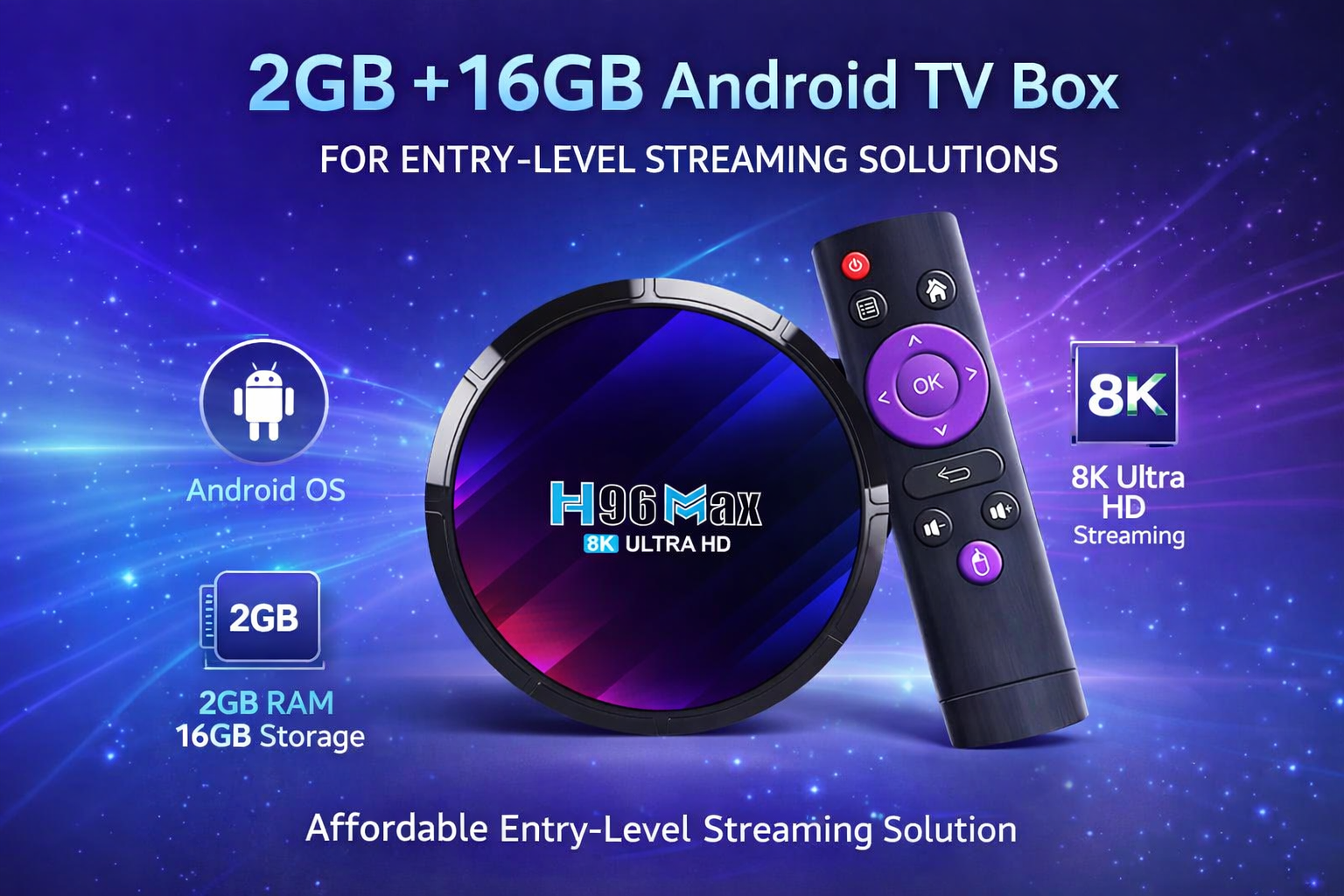
Android TV Box 2GB 16GB vs 4GB 32GB: Real-World Performance Differences Explained
When discussing Android TV Box 2GB 16GB vs 4GB 32GB, many buyers focus only on price, assuming the difference is minor. In reality, RAM and storage directly influence system responsiveness, application stability, long-term reliability, and IPTV playback performance. For distributors, IPTV operators, and system integrators, misunderstanding this difference can lead to customer complaints, high return rates, and unstable streaming experiences. This article provides a structured Android TV Box performance comparison based on actual usage scenarios rather than marketing claims. We will examine how Android TV Box RAM and Storage affect fluency, multi-tasking, app loading speed, caching behavior, and continuous IPTV playback under high load conditions.
Understanding RAM: The Core of System Responsiveness
RAM determines how many processes the system can handle simultaneously without force-closing applications. In a 2GB vs 4GB RAM TV Box comparison, the difference becomes visible once real streaming environments are considered. Android TV systems typically consume between 800MB and 1.2GB RAM at idle, depending on firmware optimization. On a 2GB configuration, this leaves limited available memory for foreground applications. Once IPTV software, decoding services, EPG updates, and background sync processes run simultaneously, memory pressure increases rapidly. In contrast, a 4GB configuration provides significantly more headroom. Applications remain cached instead of being repeatedly reloaded. The result is faster app switching, reduced system UI lag, fewer background service interruptions, and lower risk of forced app termination. According to performance testing benchmarks reported by Android Authority and XDA developer discussions, devices with 4GB RAM show up to 35–50% fewer frame drops in sustained streaming scenarios compared to 2GB devices under identical decoding workloads. This directly answers a common question: Is 2GB RAM enough for Android TV Box streaming? For light, single-app usage, possibly yes. For long IPTV sessions, multi-app environments, or 4K decoding, stability margins become narrow.
Storage Capacity: More Than Just Space
Storage is often underestimated in Android TV Box RAM and Storage discussions. The difference between 16GB and 32GB affects more than installation capacity. First, the Android operating system itself consumes 6–8GB after updates. On a 16GB device, usable storage may drop below 8GB quickly. When IPTV apps cache thumbnails, channel previews, and EPG data, storage fills progressively. When internal storage exceeds 80% usage, Android systems begin aggressive cache cleaning and background process limitation. This impacts application launch speed, IPTV channel switching delay, buffering stability, and system update reliability. In a 32GB configuration, the additional space allows stable caching behavior and reduces fragmentation. Storage read/write performance remains more consistent over time, which is crucial in long-running IPTV deployments. Media testing from GSMArena and embedded system performance studies indicates that devices with higher free storage maintain up to 20% faster average app launch speeds after six months of usage compared to low-capacity variants operating near full storage conditions.
IPTV Long-Time Playback Scenario Analysis
The real gap in Android TV Box 2GB 16GB vs 4GB 32GB appears during extended IPTV playback. In IPTV environments, the system continuously performs video decoding, network packet buffering, DRM verification, EPG synchronization, and background app retention. On a 2GB 16GB model, memory compression mechanisms activate frequently. When memory pressure rises, the system may reload IPTV apps after switching, drop background services, and increase buffering during peak traffic. Over 4–6 hours of continuous streaming, accumulated cache and log files further stress limited storage. By comparison, 4GB 32GB devices demonstrate significantly higher stability during 24/7 playback tests. System logs show reduced garbage collection spikes and fewer forced restarts. For operators asking, Should I choose 4GB 32GB Android TV Box for IPTV? the answer depends on target user behavior. For casual viewing, 2GB may survive. For hotel IPTV systems, subscription services, or commercial environments, 4GB provides a safety margin that reduces technical support incidents.
Multitasking and App Ecosystem Growth
Modern Android TV environments rarely run a single app. Users often install Netflix, YouTube, IPTV players, browsers, file managers, and screen mirroring tools. In Android TV Box performance comparison tests, 2GB devices show noticeable lag once more than three medium-weight apps are installed and updated. Google’s own Android developer guidelines recommend 4GB RAM for optimal performance in media-focused devices running Android 12 and above. This aligns with industry shifts toward heavier UI layers and larger application packages. As streaming apps continue increasing in size—many exceeding 200MB—the Best RAM for Android TV Box consideration becomes long-term compatibility rather than current minimum requirement.
4K Streaming and Decoding Workloads
When evaluating an Android TV Box for streaming 4K, RAM indirectly supports decoding efficiency. Although decoding is primarily GPU and chipset dependent, insufficient RAM can cause UI stutter during 4K playback, background task interruption, and slow return to home interface. High-bitrate 4K IPTV streams require stable buffering and consistent memory allocation. Testing by multiple OTT device reviewers shows that 4GB configurations maintain smoother frame pacing under simultaneous Wi-Fi traffic and background sync compared to 2GB variants. Thus, in Android TV Box 2GB 16GB vs 4GB 32GB decisions, 4K streaming environments benefit noticeably from the higher memory configuration.
System Stability and Return Rate Impact
From a supply chain and distributor perspective, memory configuration influences product return rates. Field feedback collected by several OEM factories indicates that entry-level 2GB models show higher complaint frequency related to freezing after updates, slow boot over time, and app crashes under IPTV load. While not defective, these limitations create perceived quality issues. 4GB 32GB configurations reduce these complaints by offering performance tolerance. In commercial Android TV Box RAM and Storage planning, investing in higher memory reduces after-sales pressure and improves brand reputation.
Cost vs Lifecycle Value
The price difference between 2GB 16GB and 4GB 32GB configurations has narrowed significantly in recent years due to memory cost reductions. When amortized over product lifecycle—especially in IPTV deployments running 8–12 hours daily—the stability benefit often outweighs the small hardware cost increase. An Android TV Box performance comparison should therefore consider deployment duration, app complexity, expected OS updates, target resolution, and commercial vs home usage. Short-term cost savings can result in long-term service inefficiencies.
Final Technical Perspective
The difference in Android TV Box 2GB 16GB vs 4GB 32GB is not cosmetic. It affects memory headroom, storage sustainability, IPTV stability, multi-app tolerance, and long-term firmware adaptability. 2GB 16GB models serve lightweight, controlled environments. 4GB 32GB configurations provide performance elasticity, especially for IPTV-heavy or 4K-focused ecosystems. If you are analyzing configuration strategies or planning IPTV-oriented hardware sourcing, our H96 Max factory team can provide deeper technical documentation, aging test data, and stability reports to support your decision-making process.
READ MORE
What Model Should Beginners Start With When Entering the TV Box Industry?
What Key Questions Should You Ask When Choosing an Android TV Box Supplier?
How to Choose the Right TV Box Model Based on Your Target Market?
What Certifications Are Required to Import Android TV Boxes in Different Countries?
What Configuration Should You Choose for an IPTV Business Android TV Box?
How to Choose Between Amlogic and Rockchip Solutions for Android TV Boxes?
10 Core Technical Parameters You Must Understand Before Buying Android TV Boxes in Bulk
Quick Links

.png "Watch H96 Max Android TV Box reviews on our YouTube channel")

.png "Explore H96 Max product photos on Instagram")