.png "H96 Max Android TV Box video reviews and tutorials on YouTube")
.png "H96 Max Android TV Box photos and lifestyle shots on Instagram")



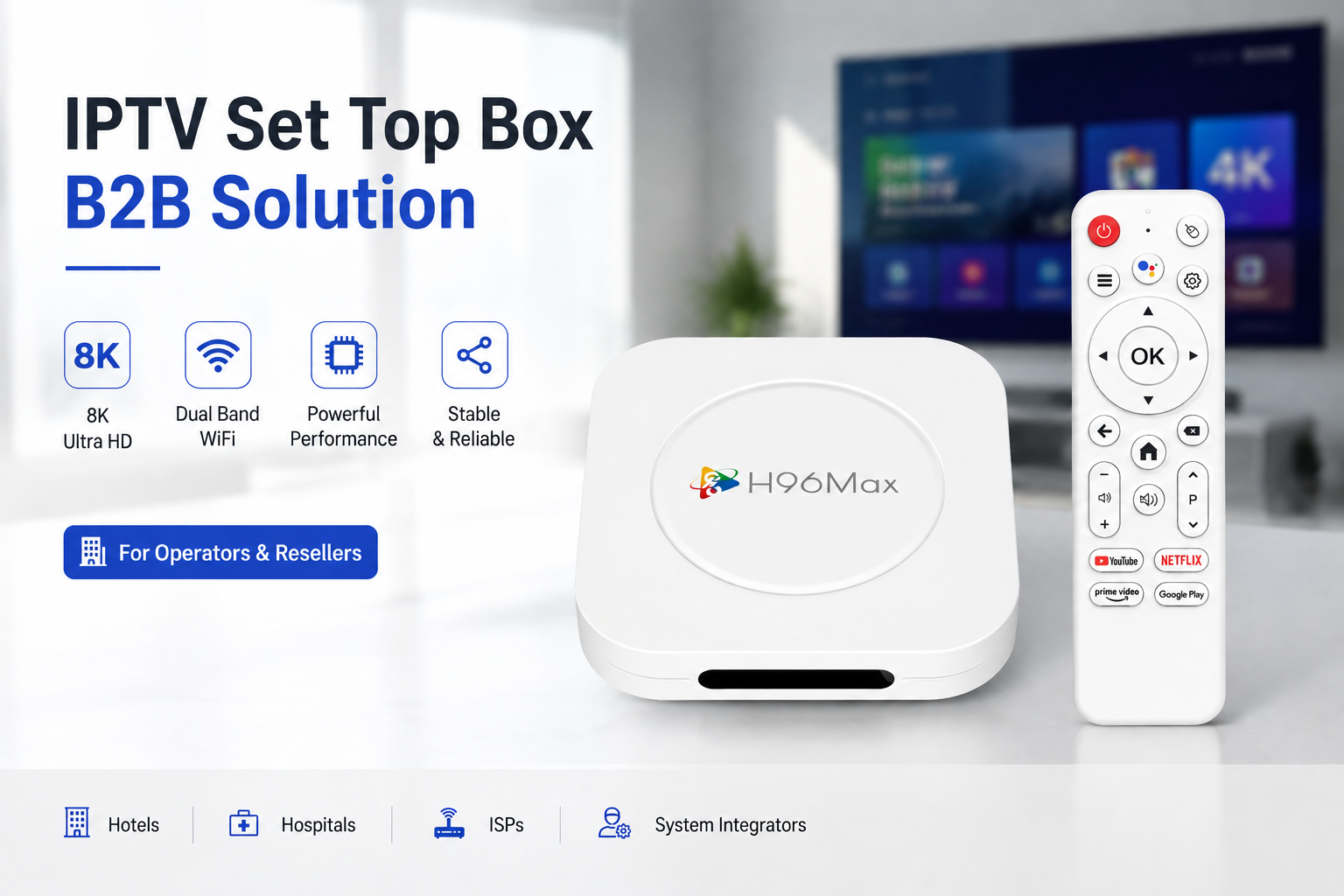
How Much Software Control Does a B2B IPTV Box Project Need?
Selecting an IPTV Set Top Box Manufacturer based only on hardware can leave B2B buyers with their largest deployment risk unresolved: software. Brands, importers, wholesalers, distributors, operators and OEM/ODM procurement teams depend on firmware for boot behavior, launcher navigation, application compatibility, networking, remote functions, updates and recovery. A sample may perform well at approval while later releases introduce regressions, or a heavily customized build may become expensive to maintain across several regional SKUs. The correct sourcing question is therefore not how many software features a factory can add, but which layers the business needs to control and how those layers will be maintained after shipment. Buyers should define software architecture, release ownership, testing, OTA governance and lifecycle support before mass production. This guide explains how to turn software customization from an open-ended feature list into a controlled B2B product capability.
Start With the Service Experience
Define the journeys customers must complete: first boot, network setup, account activation, content discovery, playback, settings, standby and recovery. Operators may also need provisioning or management workflows. These journeys should drive software requirements.
Give the IPTV Set Top Box Supplier representative applications, network assumptions and remote requirements early. A software team cannot design a stable experience when commercial expectations remain hidden until the final sample.
Choose the Android Model Precisely
If Android is required, clarify whether the product is AOSP-based or needs a particular licensed service ecosystem. Google's Android Compatibility Definition Document defines requirements for Android-compatible implementations, while individual Google services can involve separate commercial and qualification arrangements.
A professional IPTV Set Top Box Manufacturer should describe the proposed software model accurately. Buyers should verify required services and rights through appropriate authorized channels rather than accepting broad marketing claims about certification.
How Much Launcher Customization Creates Value?
A launcher can differentiate navigation, branding and content discovery, but deeper customization creates maintenance work. Start with information architecture: which apps, content categories and settings need priority, and how should users reach them with a remote?
For a Custom IPTV Set Top Box Manufacturer, branding should not be confused with usability. Validate focus movement, text readability, loading states and error handling from normal viewing distance instead of approving launcher screenshots alone.
Design for a Remote, Not a Touchscreen
Google's Android TV guidance emphasizes a ten-foot interface and D-pad navigation. IPTV applications and launchers should therefore make focus states visible and allow important actions to be completed predictably with directional controls.
Test every critical journey with the final remote. Mouse-dependent dialogs, unreachable buttons and inconsistent back behavior can turn technically functional software into a poor television experience.
Treat Remote Mapping as Software Configuration
Power, home, back, volume, shortcut and custom service keys must behave consistently across firmware and applications. Bluetooth pairing, infrared fallback and wake behavior should also be documented where applicable.
An OEM IPTV Set Top Box Manufacturer should maintain a controlled key map for each approved remote. Informal changes between firmware releases can generate support calls even when the physical remote remains unchanged.
Separate Applications From Platform Firmware
Preloaded applications change at different speeds from the operating system. Where architecture permits, buyers should avoid rebuilding complete firmware simply to update an application package. This reduces regression scope and can accelerate content-side changes.
Define who owns each application, its distribution rights, version policy and compatibility testing. The IPTV Set Top Box Manufacturer cannot guarantee the roadmap of software controlled by an unrelated third party.
Clarify Middleware Integration Early
Operator projects may depend on authentication, EPG, channel management, billing integration, analytics or proprietary middleware. Provide interfaces and test environments early enough for integration to occur before hardware and software are considered final.
Document ownership boundaries between device firmware, middleware, backend and applications. When a channel fails to load, engineering needs a structured way to determine which layer generated the problem.
Define DRM and Content Requirements Separately
Hardware decoding capability does not automatically guarantee access to every commercial streaming service or content tier. DRM, application certification and service-provider requirements can have independent technical and commercial conditions.
Ask the IPTV Set Top Box Manufacturer to distinguish platform capability from third-party authorization. Buyers should verify critical service requirements through the appropriate rights holders before promising them to customers.
Build a Production Firmware Baseline
Every production image should have a unique version, compatible hardware definition, change log, known-issue list and approval status. The factory line should flash only the release assigned to the relevant SKU.
This baseline becomes essential when field problems appear. Support teams can compare affected devices with known configurations instead of trying to diagnose an unidentified build created during development.
How Should Software Releases Be Approved?
Create release gates that separate development builds, validation candidates and production releases. Coding completion is not release approval. A candidate must pass defined functional and regression testing before reaching manufacturing or deployed devices.
The buyer and IPTV Set Top Box Manufacturer should agree who has final authority for production firmware. This prevents an urgent engineering fix from being flashed to volume units without commercial awareness.
Build Regression Around Business-Critical Journeys
Regression testing should cover boot, network setup, launcher navigation, playback, standby, wake, remote behavior, critical applications and update functions. Add tests for previously discovered high-impact defects so they do not return.
Prioritize according to business risk rather than trying to test every theoretical combination. A Wholesale IPTV Set Top Box program serving diverse users may need broader router and display coverage than a tightly managed operator deployment.
Plan OTA Architecture Before Launch
OTA design should define package targeting, integrity verification, download behavior, installation conditions, reporting and recovery. Hardware and firmware identifiers must prevent a package intended for one configuration from reaching an incompatible device.
An IPTV Set Top Box Manufacturer should demonstrate update behavior under realistic network conditions, including interrupted downloads and power-loss scenarios where appropriate. Updating successfully once in the laboratory is not sufficient evidence.
Use Staged Rollouts to Limit Exposure
Where the platform supports it, release new firmware to internal devices or a controlled cohort before broad deployment. Monitor update completion, boot stability, networking and critical applications, then expand only when evidence is acceptable.
Define who can pause a rollout and what triggers that decision. A staged process reduces the number of customers affected if a defect appears only in real-world conditions.
Recovery Is Part of OTA Design
Plan what happens if an update fails or the device cannot boot normally. Depending on the product, recovery might include retry mechanisms, alternate partitions, local procedures or service tools.
The correct architecture depends on channel economics. An operator with technicians can support procedures that are impractical for retail consumers. Recovery should be evaluated against the real cost of servicing deployed boxes.
Consider Device Management for Managed Fleets
Operators may need inventory visibility, configuration, diagnostics, update control or other management functions. Define required telemetry carefully and collect only information appropriate to the service and applicable privacy obligations.
Ask whether management is built into the platform, provided by a third party or developed specifically for the project. Each model has different integration, hosting, security and lifecycle implications.
Cybersecurity Requires an Operating Process
Google publishes monthly Android Security Bulletins describing security vulnerabilities and patch-level information. Buyers should ask how relevant upstream fixes are assessed and how chipset, platform and factory dependencies affect implementation.
For an IPTV Set Top Box Manufacturer, security maintenance should include issue intake, severity assessment, engineering ownership, testing and release communication. A one-time security review before launch cannot address vulnerabilities discovered years later.
Regulation Is Increasing Lifecycle Expectations
The European Commission states that the Cyber Resilience Act entered into force on December 10, 2024. Reporting obligations apply from September 11, 2026, and the main obligations apply from December 11, 2027.
Buyers placing potentially in-scope connected products on the EU market should obtain qualified advice. Product planning may need to consider vulnerability handling, updates, technical documentation and support periods rather than treating cybersecurity as a factory-only issue.
Avoid Firmware Fragmentation Across SKUs
Regional branding, applications and remote configurations can multiply firmware branches. Every branch requires identification, regression and maintenance. Use a shared core with controlled configuration where practical instead of duplicating the entire software tree.
Maintain a matrix connecting hardware revision, market, remote and approved firmware. This becomes increasingly valuable as repeat orders and customer variants accumulate over several years.
Control Software Changes Like BOM Changes
A firmware change can alter network behavior, performance, applications or security even when hardware is unchanged. Require change notes, impact assessment and approval for production releases just as procurement requires review for critical component substitutions.
The IPTV Set Top Box Manufacturer should preserve released builds and relevant records so a previous configuration can be investigated. Reproducibility is a core support capability.
Define Field Issue Escalation Before Shipment
Agree what information support teams should provide: model, hardware revision, firmware, application version, reproduction steps, network environment and logs where available. Define severity levels and escalation contacts.
Structured reports allow engineering to reproduce problems faster. Vague messages such as “streaming is unstable” force repeated clarification and make it difficult to distinguish device defects from network or application issues.
Measure Software Quality With Useful Metrics
Track critical defect recurrence, release success, OTA completion, rollback or recovery incidents, field issue categories and time to validated correction. Metrics should reveal whether software operations are becoming more stable over time.
Avoid using the number of firmware releases as a measure of productivity. A mature product may need fewer releases because its baseline is stable, while frequent updates can indicate unresolved quality problems.
Budget Software Over the Product Lifecycle
Customization cost does not end when the first image is delivered. Unique launcher features, middleware integrations and framework changes may require maintenance when applications, chipset SDKs or upstream Android components evolve.
Ask the IPTV Set Top Box Manufacturer which customizations create ongoing engineering obligations and what assumptions support the commercial quotation. Lifecycle cost should influence architecture decisions before development begins.
What Does a Maintainable Software Strategy Look Like?
A maintainable strategy customizes the layers that create measurable business value while preserving a stable common platform. It identifies every release, controls branches, tests critical journeys, governs OTA and defines post-launch ownership.
For B2B buyers, this discipline can be more valuable than adding another visible feature. Software becomes an operational capability that supports repeat orders and long deployments instead of an unpredictable source of field cost.
Discuss IPTV Software Customization With H96 Max
H96 Max is a source factory supporting brands, importers, wholesalers, distributors, operators and OEM/ODM procurement teams. We can discuss IPTV set top box firmware, launcher and remote customization, application integration, platform configuration, OTA requirements, pilot validation and repeat-order software control. Share your target markets, service model, required applications, management needs, expected volume and lifecycle expectations so software scope can be reviewed before unnecessary fragmentation is created. Partner with H96 Max today to explore an IPTV set top box program built around controlled software customization, scalable manufacturing and practical long-term support.
READ MORE
How to Structure an IPTV Set Top Box Manufacturing Agreement for B2B Buyers
How to Manage IPTV Set Top Box Fleets After Large-Scale Deployment
How to Plan IPTV Set Top Box Compliance for International B2B Markets
How to Calculate the True Cost of Bulk IPTV Set Top Box Procurement
How B2B Buyers Can Audit IPTV Set Top Box Quality Before Mass Production
How to Reduce IPTV Set Top Box Supply Chain Risk Before Bulk Orders
OEM vs ODM: Which IPTV Set Top Box Manufacturing Model Fits Your Business?
How to Choose an IPTV Set Top Box Manufacturer for B2B Procuremen
Quick Links

.png "Watch H96 Max Android TV Box reviews on our YouTube channel")

.png "Explore H96 Max product photos on Instagram")