.png "H96 Max Android TV Box video reviews and tutorials on YouTube")
.png "H96 Max Android TV Box photos and lifestyle shots on Instagram")



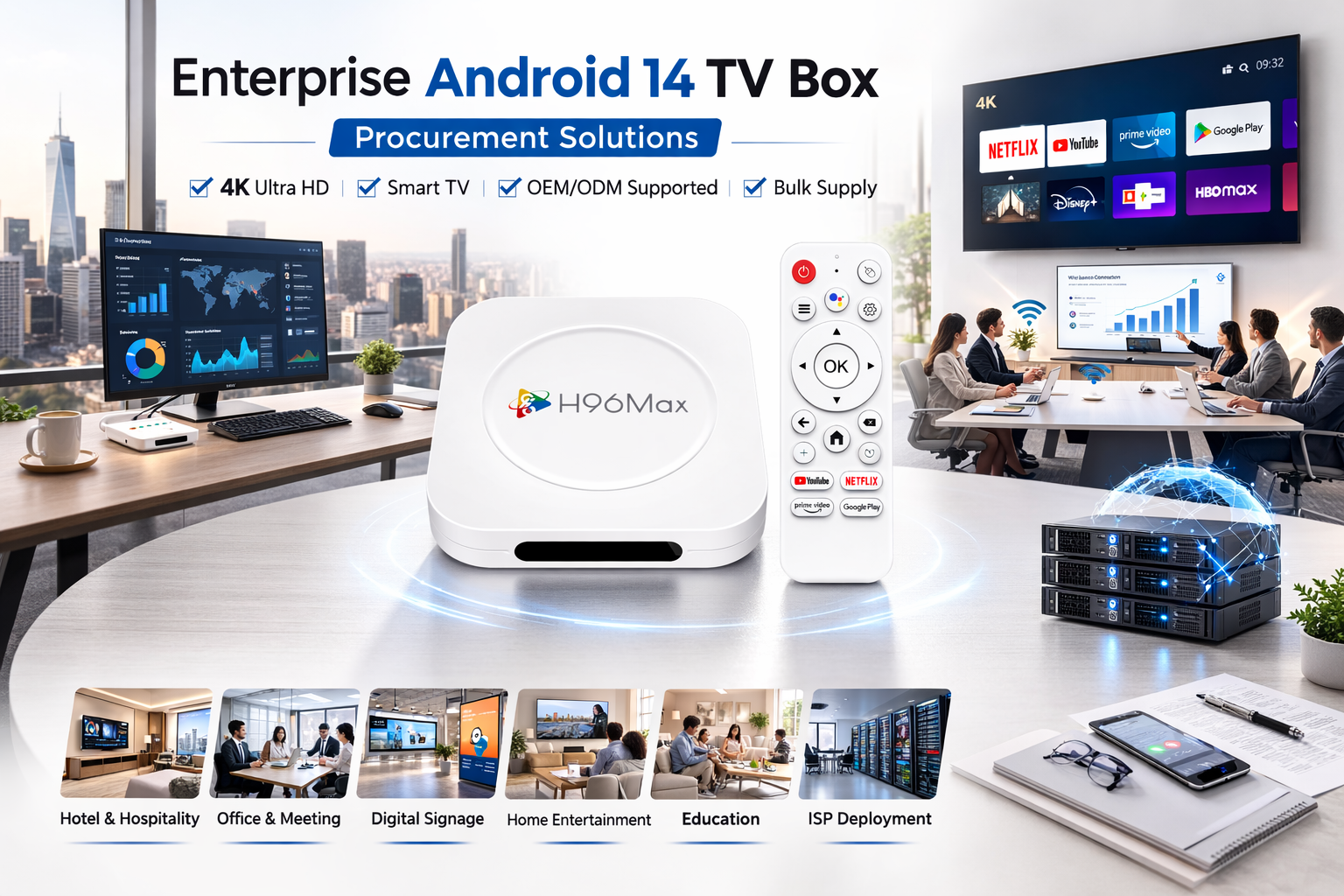
Is Android 14 TV Box Worth Bulk Buying? A Market and Technical Perspective
For distributors, brand owners, and system integrators evaluating next-generation streaming hardware, the Android 14 TV Box represents a new decision point. As operating systems mature and global OTT demand stabilizes after rapid growth between 2020 and 2023, procurement teams are increasingly asking a practical question: does upgrading to Android 14 justify large-scale inventory commitments? This analysis approaches the topic from performance, stability, security, ecosystem compatibility, and commercial risk perspectives—without sales positioning—so buyers can determine whether an Android 14 TV Box aligns with their channel strategy.
1. Market Context: Streaming Hardware in a Maturing Cycle
The global streaming device market has entered a consolidation phase. Industry research firms such as Statista and IDC have reported that while smart TV penetration continues to rise, standalone OTT devices remain relevant in emerging markets and upgrade cycles. Growth is no longer explosive, but replacement demand and 4K adoption remain steady. In this environment, procurement decisions are less about novelty and more about lifecycle longevity. Buyers considering Android 14 TV Box wholesale opportunities must assess whether the OS upgrade meaningfully extends product shelf life. Retailers are also cautious about SKU proliferation, meaning each generation must justify its position with tangible improvements rather than version-number marketing. Compared with Android 11, 12, and 13, Android 14 primarily emphasizes long-term optimization, enhanced privacy controls, and improved background process management rather than dramatic UI changes. For B2B buyers placing Android 14 TV Box bulk order volumes, this evolutionary rather than revolutionary upgrade may be both a strength and a limitation.
2. Performance Improvements Over Android 11/12/13
From a system architecture standpoint, Android 14 builds upon ART (Android Runtime) optimizations introduced in earlier versions. Google’s developer documentation highlights improvements in background task scheduling, memory efficiency, and reduced system-level latency. In practical terms, this means better memory handling in multi-app environments, improved power efficiency in standby and light-use states, and smoother UI rendering when paired with modern chipsets. However, performance gains are highly chipset-dependent. An Android 14 OTT TV Box running on an outdated SoC will not outperform a well-optimized Android 12 device using a newer processor. Therefore, buyers evaluating a 4K Android 14 TV Box must separate OS advantages from hardware capabilities. Compared with Android 11, Android 14 demonstrates stronger background process limitations, reducing memory leaks and app crashes over extended uptime. Compared with Android 12 and 13, the difference is incremental but noticeable in system stability under stress testing. For operators deploying devices in hospitality, education, or IPTV environments where uptime matters, this refinement can reduce maintenance cycles.
3. Stability and Long-Term Deployment Considerations
System stability is often more important than peak benchmark scores. Android 11 devices in early deployments sometimes faced fragmentation due to inconsistent firmware updates from various manufacturers. Android 14, benefiting from a more mature update ecosystem and stricter compatibility requirements, offers improved baseline consistency. Buyers asking “Is Android 14 TV Box worth bulk buying?” must consider firmware lifecycle management. Android 14’s modular architecture improves update delivery for security patches and system components through Google Play system updates. This reduces reliance on full firmware reflashing. For distributors working with an Android 14 TV Box manufacturer, it is critical to verify frequency of OTA updates, patch integration timelines, and custom firmware testing processes. A well-supported Android 14 TV Box may offer longer commercial viability than Android 12 or 13 units approaching end-of-support windows. However, not all manufacturers implement full update pipelines. Stability advantages only materialize when the supply partner maintains disciplined firmware control.
4. Security Enhancements and Enterprise Relevance
Security is one of Android 14’s clearest advantages over Android 11 and 12. Enhanced permission controls, stricter background access limitations, and improved encryption handling increase protection against malicious sideloaded apps. For B2B buyers serving telecom operators or enterprise IPTV clients, security compliance is increasingly non-negotiable. Android 14 strengthens data protection around app storage isolation and restricts legacy API behavior that could expose vulnerabilities. Android 13 introduced many of these changes, but Android 14 refines them further, especially in credential handling and partial media access. Compared to Android 11 devices still in circulation, Android 14 units are significantly better aligned with modern compliance expectations. That said, security improvements are more meaningful within official Android TV ecosystems than pure AOSP builds.
5. AOSP vs Android TV Ecosystem Differences
One common misconception is that all Android-based boxes offer identical user experiences. In reality, there is a structural difference between AOSP-based systems and Google-certified Android TV or Google TV ecosystems. An Android 14 TV Box running AOSP provides customization flexibility and lower licensing constraints. It allows deeper UI modifications and integration with private IPTV platforms. However, it may lack native Google Play certification, Chromecast integration, or Widevine L1 support depending on implementation. Conversely, Android TV-certified systems offer better ecosystem compatibility, official app optimization, and smoother OTT service integration. Media commentary from outlets like Android Authority often emphasizes that certification impacts long-term user experience more than OS version numbers alone. Therefore, when evaluating the Best Android 14 TV Box manufacturer for wholesale, buyers should prioritize ecosystem alignment with their distribution markets. OS version without ecosystem clarity can create post-sale friction.
6. Compatibility and App Ecosystem Maturity
Compatibility improvements in Android 14 primarily benefit modern app frameworks. Legacy applications designed for Android 9–11 environments generally remain functional, but newer SDK targets align more efficiently with Android 14. Streaming platforms continuously update DRM requirements and API dependencies. Devices locked to Android 11 may face compatibility constraints sooner than those on Android 14. However, app ecosystem maturity also depends on region. In emerging markets, sideloading and third-party IPTV platforms remain common, making AOSP-based Android 14 OTT TV Box units attractive due to flexibility. In North America and Europe, certification and official app support may outweigh OS recency. Thus, Android 14’s ecosystem advantage is contextual rather than universal.
7. Commercial Risk and Inventory Strategy
From a procurement standpoint, OS version influences product lifecycle duration, marketing positioning strength, and post-sale technical support burden. An Android 14 TV Box wholesale strategy may provide marketing differentiation in competitive B2B tenders, especially when clients demand “latest version” compliance. However, the price delta compared to Android 13 devices must be justified by tangible deployment benefits. If target markets prioritize cost over lifecycle extension, Android 13 models may remain commercially viable. If buyers require 3–5 year deployment confidence, Android 14 offers greater future-proofing. Inventory risk also depends on chipset roadmap alignment. OS advancement without chipset longevity may limit resale flexibility.
8. Limitations Buyers Should Not Ignore
Despite its strengths, Android 14 does not radically transform streaming performance. Video decoding capability still depends primarily on hardware acceleration. A 4K Android 14 TV Box will not outperform an older version if both share identical GPU and decoder configurations. Additionally, some legacy IPTV middleware solutions require optimization adjustments when migrating from Android 11 to Android 14 due to permission structure changes. There is also the transitional period challenge: application developers may initially optimize for Android 13 before fully targeting Android 14-specific improvements. Therefore, bulk procurement should follow pilot testing rather than assumption-based upgrading.
Conclusion: Strategic Upgrade or Incremental Step?
The Android 14 TV Box is not a disruptive leap but a strategic refinement. Compared with Android 11, it offers meaningful improvements in security, background management, and lifecycle sustainability. Compared with Android 12 and 13, the benefits are incremental yet commercially relevant for long-term deployments. Whether Android 14 TV Box bulk order commitments are justified depends on market positioning, firmware support reliability, ecosystem alignment, and deployment horizon. For distributors serving regulated markets or multi-year IPTV contracts, Android 14 strengthens compliance and stability confidence. For cost-sensitive retail markets, the difference may be less decisive. Careful evaluation of the Android 14 TV Box manufacturer’s update discipline, hardware roadmap, and ecosystem certification remains more critical than the OS version alone. For buyers seeking technical transparency and direct collaboration with a source factory experienced in structured firmware management and large-scale production, H96 Max can provide detailed engineering documentation and production insight to support informed partnership decisions.
READ MORE
What Model Should Beginners Start With When Entering the TV Box Industry?
What Key Questions Should You Ask When Choosing an Android TV Box Supplier?
How to Choose the Right TV Box Model Based on Your Target Market?
How Big Is the Difference Between 2GB+16GB and 4GB+32GB Android TV Boxes?
What Certifications Are Required to Import Android TV Boxes in Different Countries?
What Configuration Should You Choose for an IPTV Business Android TV Box?
How to Choose Between Amlogic and Rockchip Solutions for Android TV Boxes?
10 Core Technical Parameters You Must Understand Before Buying Android TV Boxes in Bulk
Quick Links

.png "Watch H96 Max Android TV Box reviews on our YouTube channel")

.png "Explore H96 Max product photos on Instagram")