.png "H96 Max Android TV Box video reviews and tutorials on YouTube")
.png "H96 Max Android TV Box photos and lifestyle shots on Instagram")



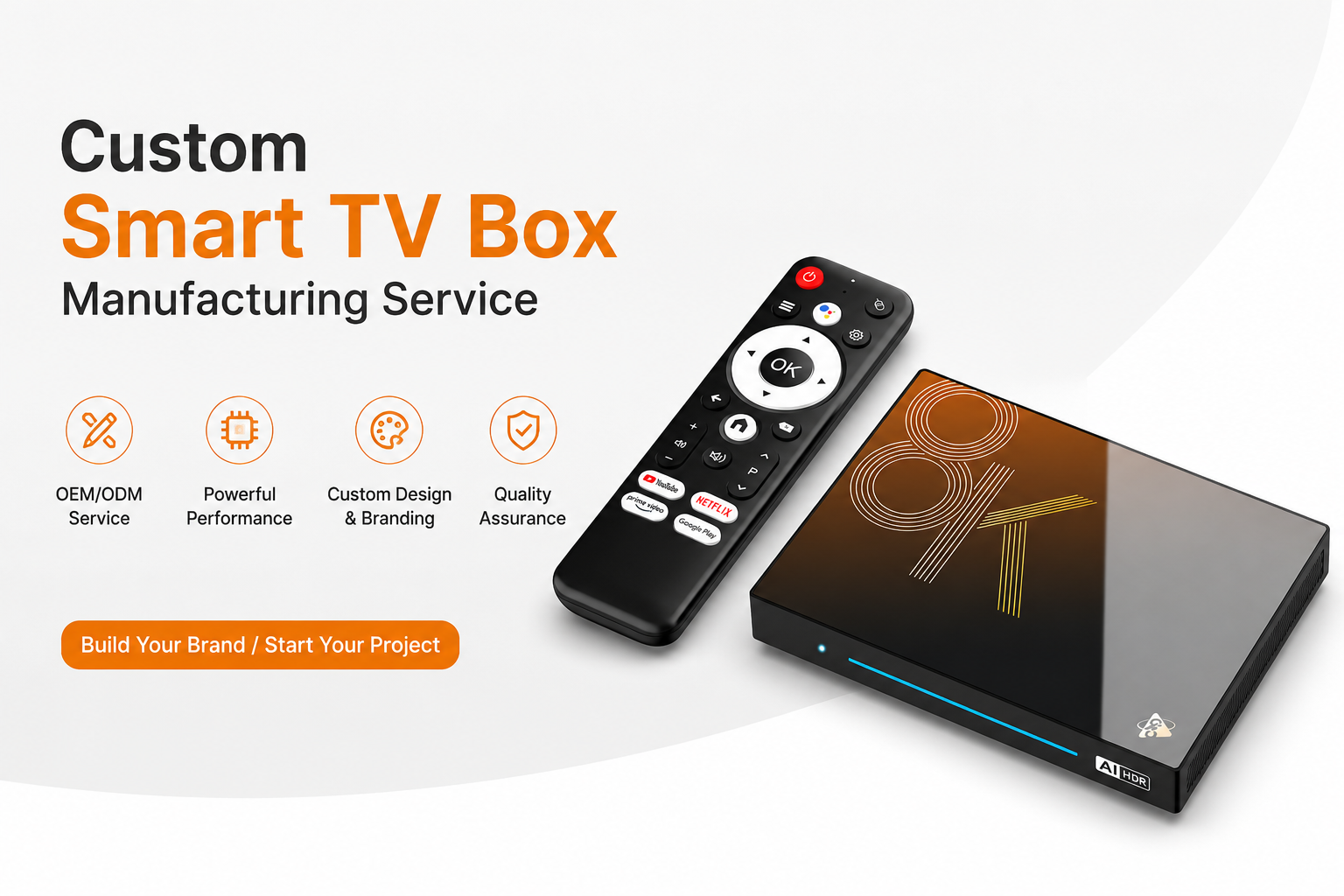
Why Integrated ODM Matters for Building a Scalable Branded Device
One-stop ODM has become a preferred model because connected-device programs rarely succeed through hardware alone. As streaming, hospitality, enterprise display, and operator ecosystems expand, the Custom Smart TV Box is increasingly expected to function as a branded gateway rather than a simple playback device. Buyers need a product that aligns chipset performance, software behavior, app strategy, packaging, launch timing inside a execution path. When these workstreams are managed separately, delays and mismatches accumulate quickly.
The broader market also explains why integration has become a strategic issue. GSMA’s 2025 State of Mobile Internet Connectivity reporting shows global mobile internet use continued to expand through 2024, strengthening the connected-screen environment around apps, streaming, and digital services. IAB’s 2025 Digital Video Ad Spend report says digital video is expected to approach 60% of U.S. TV/video ad spend in 2025, underscoring how strongly value is shifting toward connected viewing environments. Official compliance frameworks remain strict: the European Commission states that manufacturers are responsible for ensuring products meet applicable EU requirements before CE marking, and the FCC requires RF devices to be properly authorized before being marketed or imported into the United States. For a Custom Smart TV Box, product success depends on coordination across engineering, software, branding, and compliance rather than on one specification sheet.
What One-Stop ODM Really Means
Many buyers use the phrase one-stop solution loosely, but in practice it should mean something specific. A true integrated ODM program combines product definition, platform selection, industrial design, software adaptation, accessory planning, packaging, compliance preparation, pilot validation, and production control inside one coordinated project structure. It does not mean a factory simply offers several optional services on a quotation. It means the partner can connect each decision to the others so that the final product launches with fewer surprises.
This distinction matters because many B2B buyers have experienced fragmented execution. One team may supply the main hardware. Another may attempt to modify Android. A third may handle packaging. The result can be repeated revisions, unclear responsibility, and late discovery of incompatibilities between branding goals and technical limits. A capable Custom Smart TV Box Manufacturer reduces this complexity by treating the device as a unified product system rather than as a set of disconnected tasks.
Why Integration Creates Commercial Value
The commercial value of one-stop ODM is not convenience alone. Integration helps buyers reduce three of the most expensive risks in device projects: launch delay, brand inconsistency, and lifecycle support cost. When hardware and software teams do not align early, the product may ship with unstable UI behavior, inappropriate memory sizing, or incomplete application support. When branding is treated as a late-stage overlay, the external identity may not match the setup flow or service model. When compliance is handled too late, shipping commitments may collide with certification realities.
A well-managed Custom Smart TV Box program prevents these problems by forcing alignment earlier in the cycle. The hardware bill of materials is defined in light of software goals. The software plan is reviewed in light of target users and remote-based interaction. Packaging and labels are checked against market requirements. Pilot production is tested against real use scenarios instead of abstract assumptions. For brands, operators, and distributors, this alignment protects revenue because it reduces rework and improves launch reliability.
Hardware Integration: Performance Must Serve the Use Case
One-stop ODM begins with hardware decisions, but those decisions should be driven by commercial logic. CPU, RAM, storage, wireless modules, port layout, thermal structure, and adapter strategy all need to reflect the deployment scenario. A box for mainstream OTT consumption may require a different balance from a device built for hospitality, education, enterprise communication, or digital signage. A generic spec upgrade does not automatically create value if the use case does not benefit from it.
An experienced OEM Smart TV Box Supplier should therefore begin with requirements such as content behavior, user density, update frequency, app complexity, regional connectivity conditions, and expected support model. In a one-stop structure, these hardware decisions are not isolated from software planning. Memory sizing must account for launcher complexity, background services, and OTA headroom. Wireless design must account for enclosure material and certification implications. Port layout must reflect peripheral expectations. A strong Custom Smart TV Box is built when these choices are coordinated rather than improvised.
Software Integration: The Product Is Experienced Through the Interface
If hardware defines the foundation, software defines how the customer experiences that foundation. Android adaptation, launcher logic, boot animation, key mapping, app arrangement, account flow, OTA strategy, all shape how the device performs in the market. Buyers may begin with hardware comparisons, but end users judge the product through startup speed, navigation clarity, remote responsiveness, and update stability.
That is why Custom Smart TV Box OEM ODM Solutions for Global Brands and IPTV Providers should be evaluated as systems, not as hardware transactions with optional firmware services. A retail-focused device may need a visually branded home screen and simplified onboarding. An operator box may need middleware compatibility and service-first activation. A hospitality deployment may need restricted settings and remote fleet control. In each case, software decisions influence support cost as much as user satisfaction.
A serious partner also understands that software integration continues after first shipment. Regression testing, bug tracking, build approval, staged OTA rollout, and rollback planning should be part of the one-stop structure. Without that governance, the product may launch well but become unstable once content partners, apps, or market requirements change.
Branding Integration: Identity Must Appear in Every User Touchpoint
Branding is often reduced to logo printing, yet that is one of the weakest interpretations of private-label strategy. A Private Label Smart TV Box should feel coherent across casing finish, LED behavior, remote design, packaging structure, quick-start guide language, setup flow, home-screen hierarchy. If hardware looks premium but the interface feels generic, the product loses credibility. If the launcher is polished but the unboxing experience looks improvised, trust drops before the customer even turns the device on.
This is why one-stop ODM is valuable for brand-building. The factory or development partner can align external identity with internal experience. Industrial design decisions can be reviewed together with software mockups. Packaging language can reflect the onboarding sequence. Remote keys can support the intended home-screen logic. The result is not merely a branded shell, but a more complete Private Label Smart TV Box that supports positioning in retail, operator, or enterprise channels.
For many buyers, this is also where channel differentiation is created. If dozens of sellers offer similar hardware, the businesses that win often do so through a clearer experience and presentation. A coordinated Custom Smart TV Box can strengthen price discipline by giving the buyer something more distinctive than a catalogue unit with a changed logo.
Compliance and Supply Chain Integration Prevent Failure
A one-stop model must also connect design work to compliance and supply chain planning. The European Commission makes clear that manufacturers are responsible for conformity assessment, technical documentation, and CE marking obligations. The FCC likewise requires proper authorization of RF devices before U.S. marketing or import. These responsibilities affect Wi-Fi modules, adapters, labels, user guides, packaging text, and engineering change control. They cannot be handled responsibly if branding, sourcing, and hardware teams work in isolation.
Supply chain strategy is equally important. Component substitutions, memory sourcing, remote availability, and adapter changes can all alter performance or documentation assumptions. In a fragmented project, these changes may only appear when timelines are already tight. A one-stop ODM structure helps buyers connect sourcing alternatives with engineering validation and labeling control before shipment risk becomes visible.
This is one practical answer to the question How to Choose a Reliable Custom Smart TV Box Manufacturer for Your Business. Reliability is not just about factory scale or a competitive quote. It is about whether the partner can manage interdependence across BOM control, software maintenance, packaging updates, approvals, and production traceability without losing project clarity.
What Buyers Should Evaluate Before Choosing an Integrated ODM Partner
Before committing to a one-stop program, buyers should examine whether the supplier has integration capability or is only coordinating outsourced pieces. They should ask who owns product management, who supervises firmware milestones, how packaging revisions are approved, how pilot runs are validated, and how engineering changes are linked to compliance documentation. They should also evaluate communication quality. Slow or unclear communication can be as damaging as weak hardware.
The right partner should be able to explain trade-offs transparently. Not every device needs maximum customization. Some programs benefit from a largely standardized platform with targeted branding and launcher adjustments. Others require deeper control because the box is central to subscription services, enterprise workflows, or operator delivery. A good Android TV Box Wholesale Supplier with real ODM capability will identify which changes create market value and which changes only add cost and maintenance burden.
Final Perspective
One-stop ODM solutions matter because connected-device projects are no longer won through hardware specification alone. Buyers need alignment across hardware architecture, Android customization, app strategy, private-label presentation, compliance planning, and mass-production governance. When those elements are integrated, the Custom Smart TV Box becomes easier to launch, easier to support, and more credible in the market. When they are fragmented, hidden costs and delays grow quickly.
For brands, operators, and distributors planning a device roadmap, H96 Max offers support across hardware integration, software coordination, branding implementation, compliance preparation, and scalable production management. The most effective next step is to align commercial goals, product scope, and market requirements with a partner that can manage the full system responsibly. Partner with H96 Max today.
READ MORE
How to Choose a Reliable Smart TV Box ODM Manufacturer for Long-Term Partnership
Smart TV Box ODM Cost Breakdown: How to Control Budget and Maximize ROI
How Custom Smart TV Boxes Help Operators and Brands Increase Revenue
Smart TV Box Certification Guide: Google TV, Netflix, CE, FCC and Global Compliance
Android System & UI Customization: Building a Unique Smart TV Experience
Smart TV Box Hardware Customization Guide: CPU, RAM, Storage and Design Options
From Concept to Mass Production: Complete Smart TV Box ODM Development Process
OEM vs ODM Smart TV Box: Which Business Model Is Better for Your Brand?
Custom Smart TV Box Explained: Why Global Brands Choose OEM/ODM Solutions
Quick Links

.png "Watch H96 Max Android TV Box reviews on our YouTube channel")

.png "Explore H96 Max product photos on Instagram")