.png "H96 Max Android TV Box video reviews and tutorials on YouTube")
.png "H96 Max Android TV Box photos and lifestyle shots on Instagram")



How to Build a Cost Structure That Supports Margin, Stability, and Growth
Custom Smart TV Box projects rarely fail because buyers do not ask for enough features. They fail because cost planning is too shallow. In many B2B device programs, the first quotation becomes the center of the discussion, even though it reflects only part of the real financial picture. For operators, distributors, retailers, and solution providers, the cost of a streaming device includes hardware, software scope, compliance work, packaging, tooling, testing, project management, quality control, logistics coordination, after-sales risk, and update obligations. A well-managed Custom Smart TV Box strategy is not about finding the lowest quote. It is about creating the best ratio between cost, market fit, reliability, and monetization potential.
This financial question matters more as connected viewing grows. GSMA’s latest State of Mobile Internet Connectivity reporting shows mobile internet use kept expanding through 2024, increasing movement between apps, smart screens, and digital services. IAB says digital video is expected to approach 60% of U.S. TV and video ad spend in 2025. In that environment, a Custom Smart TV Box should be costed as part of a service model, not merely as electronics.
Why the Lowest Unit Price Often Produces the Highest Real Cost
Procurement teams often compare several factories and focus on ex-works price. That comparison is useful, but limited. A low initial price can hide compromises in memory quality, wireless stability, adapter sourcing, packaging accuracy, test coverage, firmware maintenance, or engineering support. These risks rarely appear during sampling. They surface later through delayed launches, rework, returns, or support tickets. The cheapest quotation can become the most expensive program after deployment.
This is why experienced buyers ask for a cost breakdown rather than a single number. They want to know how the bill of materials is structured, what tooling assumptions apply, how compliance work is handled, what software tasks are extra, and how production testing is organized. A serious Custom Smart TV Box Manufacturer should be willing to explain these layers clearly. Transparent costing is often a better sign of factory maturity than a low opening quote.
The Core Cost Layers in an ODM Smart TV Box Project
The first layer is the hardware bill of materials. This includes the chipset, RAM, storage, wireless module, PCB, enclosure materials, connectors, remote control, adapter, packaging, labels, and accessories. Small component choices can change cost structure. Faster memory may improve responsiveness but increase unit price. A stronger wireless module may improve stability while affecting certification scope. Higher storage may reduce future OTA problems but change device positioning. A Custom Smart TV Box should therefore be costed against the use case, not against an abstract target number.
The second layer is software and system adaptation. Many buyers underestimate this because software does not always appear clearly in hardware quotations. Costs may come from launcher customization, boot animation, app preload logic, key mapping, localization, middleware alignment, OTA workflow, bug fixing, and version maintenance. In a project that depends on service activation or private-label positioning, software is not optional decoration. It is part of the commercial engine.
The third layer includes compliance, testing, and documentation. The European Commission says manufacturers are responsible for ensuring products meet applicable EU requirements before CE marking, and the FCC requires RF devices to be properly authorized before they are marketed or imported into the United States. These obligations influence test planning, documentation, labels, adapters, module choices, and engineering-change control. For global buyers, compliance cost should be treated as part of launch planning, not as a late surprise.
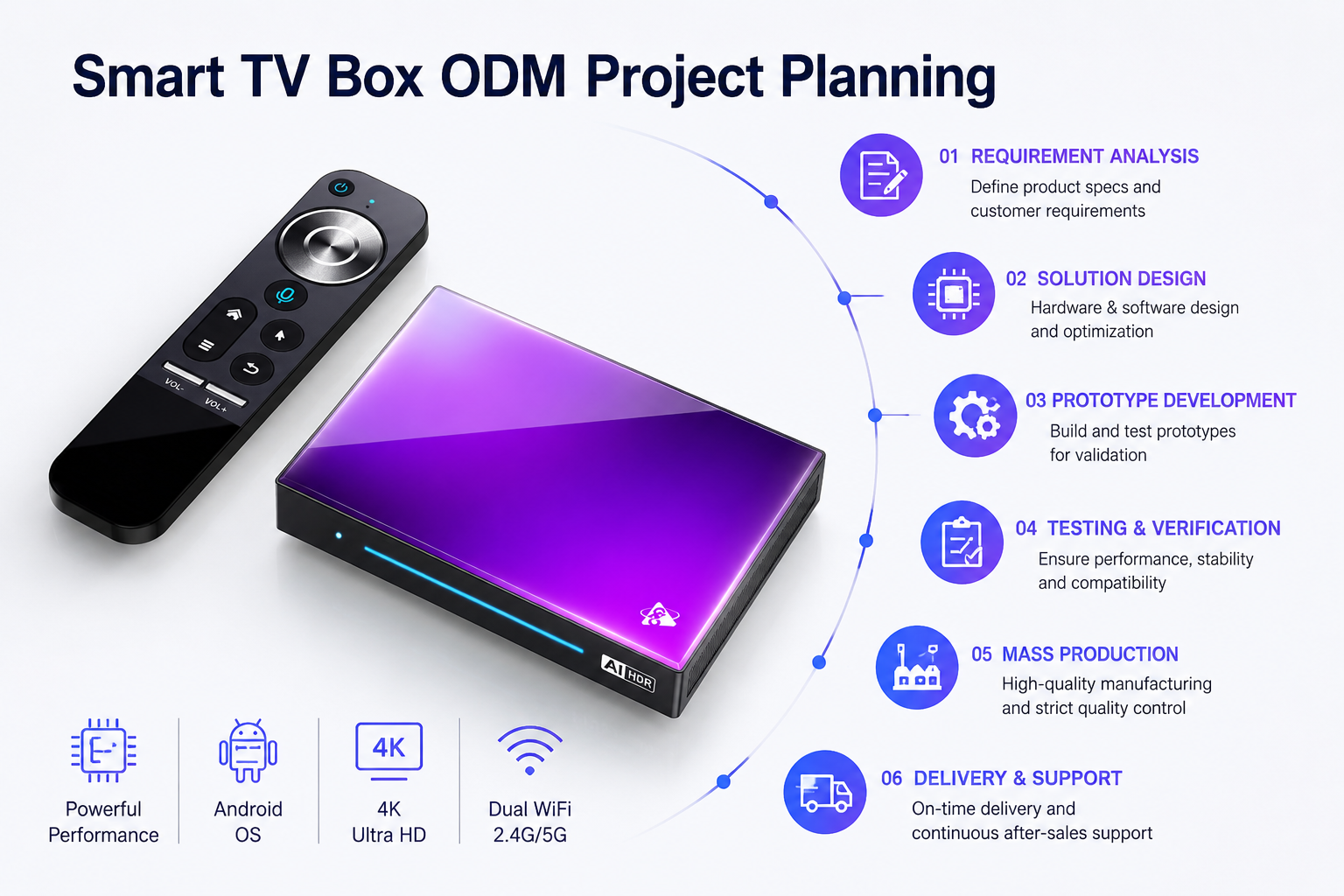
The fourth layer is project execution. Sampling cycles, packaging revisions, pilot runs, production validation, and communication overhead all consume time and money. These costs are often hidden when teams assume engineering support is included. A disciplined Custom Smart TV Box program makes these workstreams visible early.
How Hardware Choices Affect Budget More Than Buyers Expect
Hardware cost is not driven only by performance targets. It is also driven by sourcing stability and product definition discipline. Buyers who keep changing CPU level, memory size, enclosure design, or port layout during development usually create avoidable expense. Every engineering change can ripple into PCB review, thermal validation, packaging revision, and schedule pressure. An experienced OEM Smart TV Box Supplier should help buyers lock the right architecture early so that later changes are limited to items with clear commercial value.
Over-specification is a common budget problem. Some teams request the highest configuration available because they fear future complaints. But if the use case is standard streaming with limited multitasking, the premium may not create proportional value. Under-specification is equally risky because poor performance can increase support cost and damage retention. A strong Android TV Box Wholesale Supplier with ODM capability should be able to show where higher spend improves conversion and where it simply erodes margin.
Software Scope Is a Major ROI Variable
ROI improves when software customization supports measurable business goals. If the box is meant to activate subscriptions, sell premium content, surface ads, or reinforce brand identity, launcher structure and onboarding logic matter financially. If the device is for enterprise or hospitality use, provisioning, restricted access, and OTA discipline matter financially. A Private Label Smart TV Box without coherent software planning may save money at launch but lose value later through poor activation or weak customer satisfaction.
That is why buyers should connect software budget to revenue outcomes. Does the customized launcher increase account creation? Does the setup flow reduce abandonment? Does better OTA governance reduce field failure? Does localized UI reduce support tickets in target markets? A Custom Smart TV Box becomes easier to justify when each software decision is tied to conversion, retention, or operating efficiency.
This is also where many companies begin searching for How to Choose a Reliable Custom Smart TV Box Manufacturer for Your Business. They are looking for a partner that understands the financial meaning of firmware stability, version control, and post-launch support rather than treating software as an unlimited free add-on.
Tooling, Packaging, and Branding Costs Need Discipline Too
Branding expenses are often underestimated because they look small compared with the main BOM. In reality, repeated casing modifications, mold changes, logo-method revisions, carton redesign, manual updates, insert changes, and barcode relabeling can gradually push a project off budget. A Private Label Smart TV Box should therefore follow a controlled branding plan that locks key decisions before mass production preparation begins.
Packaging cost should be evaluated beyond printing. Carton strength, insert design, adapter combinations, and labeling control all affect logistics efficiency and damage risk. For global channels, packaging discipline also supports compliance.
Compliance and Quality Control Are Cost Protection Mechanisms
Some buyers try to reduce cost by minimizing test scope or post-production quality control. That is a false economy. Compliance failures, inconsistent firmware, unstable Wi-Fi performance, or weak packaging inspection can create costs that far exceed the money saved at the factory. The official CE and FCC frameworks exist because market access depends on disciplined conformity and authorization processes. In commercial terms, compliance spending often protects revenue by preventing delay and disruption.
Quality control works the same way. Incoming inspection, production testing, pilot-run analysis, carton checks, and shipment traceability all add process cost, but they also reduce return exposure and channel complaints. For a Custom Smart TV Box, ROI is stronger when defect prevention is built into the model rather than treated as an optional extra.
How to Evaluate ROI in a Smarter Way
Return on investment should be modeled across multiple dimensions. Buyers should look at gross margin per unit, activation rate, subscription conversion, advertising opportunity, support cost per active device, return rate, update stability, replacement cost, and expected product life. A project with a slightly higher build cost may still create better ROI if it launches faster, converts users more effectively, and stays stable longer in the field.
This is particularly true for Custom Smart TV Box OEM ODM Solutions for Global Brands and IPTV Providers. In these projects, the device often supports a larger service model. Revenue comes not only from hardware sales, but from subscriptions, advertising, enterprise deployment, or long-term account ownership. The right question is not “How can I make the box cheaper?” but “How can I make the box more profitable?”
What Buyers Should Ask Before Approving the Budget
Before approving a project, buyers should ask for a clear breakdown of BOM assumptions, software scope, tooling responsibility, certification plan, packaging variations, test procedures, defect targets, and post-launch support terms. They should also ask what happens if a key component becomes unavailable or if a market requires a labeling change. Transparent answers reduce the risk of hidden expense later.
The best suppliers do not simply chase the lowest headline price. They explain trade-offs between speed, stability, brand control, and cost. A capable Custom Smart TV Box Manufacturer or OEM Smart TV Box Supplier should be willing to show where budget can be optimized safely and where cutting too far will harm the business case.
Final Perspective
Controlling budget in a smart TV box project is not about compressing every line item. It is about aligning cost with use case, channel model, software needs, compliance path, and long-term monetization. When buyers understand the real cost structure, they can avoid false savings, protect launch timing, and improve ROI through better product decisions. H96 Max offers source-factory support across hardware integration, software coordination, branding execution, compliance planning, and scalable production management. The next step is to align financial goals with product scope and build with a partner that can manage both responsibly. Partner with H96 Max today.
READ MORE
How to Choose a Reliable Smart TV Box ODM Manufacturer for Long-Term Partnership
How Custom Smart TV Boxes Help Operators and Brands Increase Revenue
One-Stop Smart TV Box ODM Solutions: Hardware, Software and Branding Integration
Smart TV Box Certification Guide: Google TV, Netflix, CE, FCC and Global Compliance
Android System & UI Customization: Building a Unique Smart TV Experience
Smart TV Box Hardware Customization Guide: CPU, RAM, Storage and Design Options
From Concept to Mass Production: Complete Smart TV Box ODM Development Process
OEM vs ODM Smart TV Box: Which Business Model Is Better for Your Brand?
Custom Smart TV Box Explained: Why Global Brands Choose OEM/ODM Solutions
Quick Links

.png "Watch H96 Max Android TV Box reviews on our YouTube channel")

.png "Explore H96 Max product photos on Instagram")