.png "H96 Max Android TV Box video reviews and tutorials on YouTube")
.png "H96 Max Android TV Box photos and lifestyle shots on Instagram")



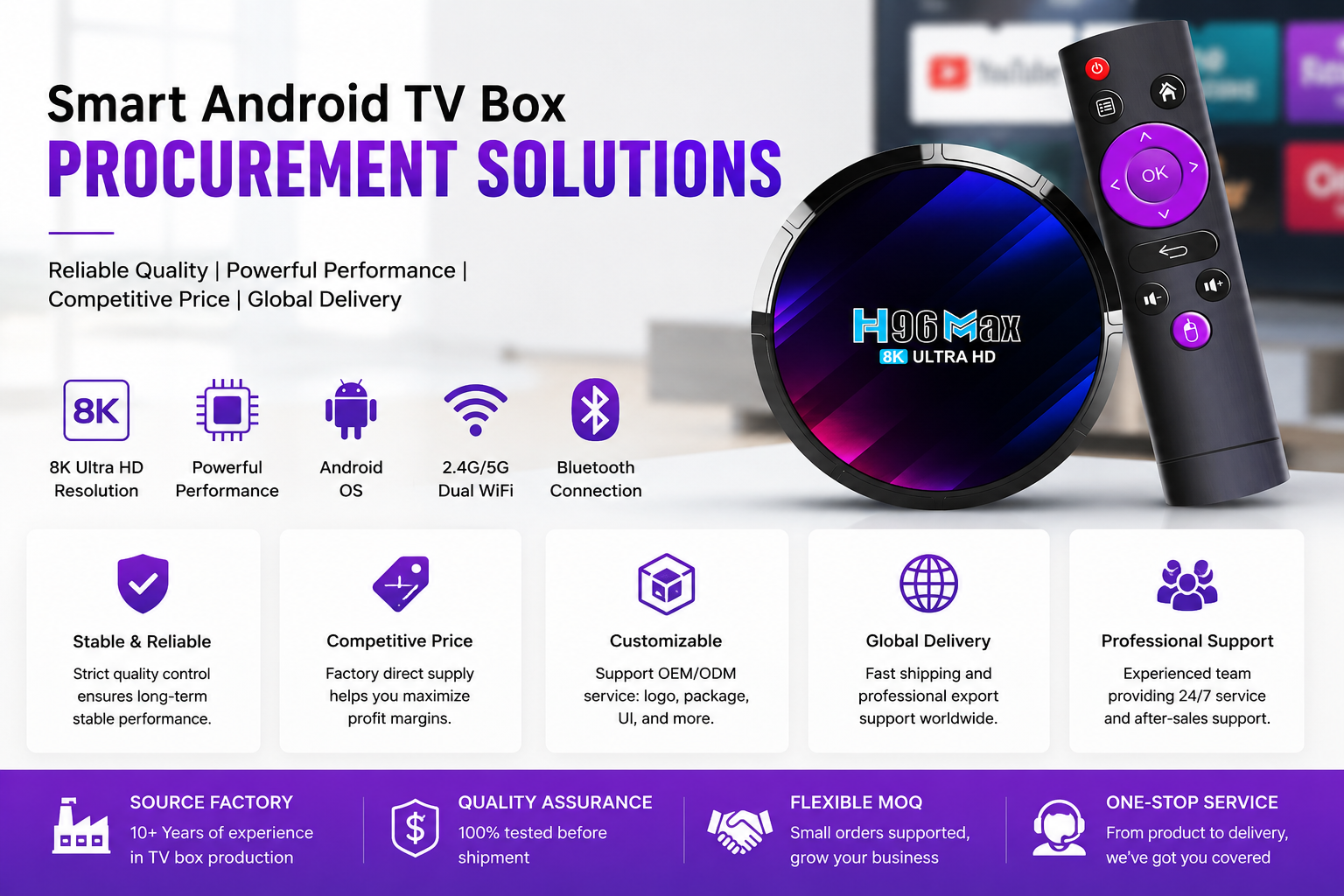
A Practical Framework for Evaluating Android TV Box Suppliers
As the global streaming device market becomes increasingly competitive, selecting the right supplier has evolved from a simple purchasing task into a strategic business decision. For distributors, telecom operators, IPTV providers, wholesalers, and e-commerce sellers, establishing a reliable Android TV Box Supplier Partnership is essential for maintaining product quality, operational stability, and long-term profitability.
The Android streaming ecosystem continues expanding rapidly due to rising OTT adoption, connected home technology, and growing demand for affordable smart entertainment devices. According to reports from Deloitte, Statista, and Grand View Research, global demand for Android-based TV devices is expected to maintain strong growth through 2026 and beyond. However, this growth also increases sourcing complexity. Businesses now face procurement challenges involving firmware reliability, logistics volatility, certification compliance, inventory planning, and evolving consumer expectations.
Many businesses still make supplier decisions primarily based on pricing. Unfortunately, low-cost procurement often creates hidden operational risks, including unstable firmware, inconsistent product quality, delayed shipments, and high return rates. Companies involved in B2B TV box procurement are increasingly recognizing that long-term supplier performance matters far more than short-term pricing discounts.
This shift explains why modern procurement teams are placing greater emphasis on building strategic relationships with experienced Android TV Box wholesale suppliers capable of supporting scalable and sustainable business growth.
Why Supplier Evaluation Is More Important Than Ever
The Android streaming device market has become significantly more complex over the past several years. Customers now expect smoother user interfaces, faster processors, stable OTA updates, AI-enabled features, and stronger application compatibility.
As a result, businesses can no longer rely on purely transactional procurement strategies. A professional Smart TV box supplier partnership now directly influences customer satisfaction, inventory stability, warranty costs, and operational efficiency.
Research from McKinsey indicates that supply chain resilience has become one of the most important competitive advantages within electronics-related industries. Businesses with stronger supplier collaboration frameworks generally recover more effectively from logistics disruptions and component shortages.
One major challenge in Android TV box bulk purchase projects is balancing cost control with operational reliability. Suppliers focused only on low pricing often compromise component quality, testing procedures, or firmware maintenance. These shortcuts frequently create higher long-term operational costs.
Experienced procurement organizations therefore approach supplier evaluation through a broader operational lens focused on long-term value creation rather than initial pricing alone.
Step 1: Verify Manufacturing Capability
The first stage of supplier evaluation involves understanding the manufacturer’s production capacity and operational structure.
Many businesses unknowingly work with trading intermediaries rather than direct factories. While trading companies may provide attractive pricing, they often lack direct control over production quality and delivery schedules.
Buyers should therefore verify whether suppliers operate their own manufacturing facilities or outsource production to third-party factories. Factory audits, production videos, manufacturing certifications, and operational transparency help confirm production credibility.
Production scalability is equally important. Suppliers capable of handling small orders may struggle during periods of rapid demand growth. Businesses planning long-term expansion should prioritize suppliers capable of scaling production while maintaining quality consistency.
According to Gartner research, supply chain visibility significantly improves procurement performance and operational forecasting accuracy.
Reliable suppliers generally provide transparent information regarding production systems, testing procedures, staffing structure, and manufacturing capacity.
Step 2: Evaluate Quality Control Systems
Quality management plays a critical role in long-term procurement success. Weak quality control systems often lead to higher defect rates, warranty claims, and customer dissatisfaction.
Professional manufacturers typically implement detailed inspection procedures across multiple production stages. These may include incoming material testing, PCB inspections, thermal validation, functional testing, aging tests, firmware verification, and packaging inspections.
Buyers should request quality documentation and defect rate reports before committing to large procurement agreements.
Another important consideration is component consistency. Some low-cost suppliers use different components across production batches, creating inconsistent product performance and customer experiences.
Strong quality management systems reduce operational uncertainty while improving customer satisfaction and long-term profitability.
According to PwC, businesses implementing mature quality governance systems often achieve stronger operational resilience and lower warranty-related costs.
Step 3: Assess Firmware Engineering Capability
Modern streaming devices depend heavily on software performance. Firmware stability directly affects user experience, application compatibility, OTA updates, and long-term product viability.
Suppliers lacking dedicated software engineering teams frequently struggle to maintain firmware quality as streaming applications evolve. Weak firmware optimization often results in crashes, slow performance, compatibility problems, and poor customer reviews.
Businesses evaluating suppliers should therefore examine OTA update systems, multilingual support capabilities, application testing procedures, and software maintenance workflows.
Industry analysts from IDC predict that firmware reliability will become even more important as AI integration and smart home connectivity continue expanding.
A successful Android TV Box Supplier Partnership requires suppliers capable of supporting long-term firmware optimization and responsive technical support.
Businesses that underestimate firmware quality often encounter higher return rates and reduced customer retention.
Step 4: Analyze Logistics and Supply Chain Support
Global logistics volatility has transformed how businesses evaluate procurement partners. Shipment delays, fluctuating transportation costs, and customs disruptions continue affecting supply chains worldwide.
Reliable suppliers help businesses manage these risks through stronger logistics coordination and operational flexibility.
Buyers should evaluate whether suppliers can support different shipping methods, regional warehousing coordination, export documentation, and inventory planning assistance.
Logistics responsiveness is particularly important for businesses operating across multiple international markets. Delayed communication or weak shipment coordination often creates expensive operational disruptions.
Research from Deloitte indicates that companies with stronger supply chain collaboration frameworks achieve better resilience during periods of global market instability.
Businesses seeking long-term operational stability should therefore prioritize suppliers with extensive export experience and flexible logistics support capabilities.
Step 5: Evaluate Communication Transparency
Communication efficiency is one of the most overlooked aspects of supplier evaluation. Poor coordination frequently creates avoidable delays, forecasting confusion, and operational inefficiencies.
Reliable suppliers maintain transparent communication systems throughout production and logistics stages. Buyers should expect consistent project updates, responsive support, and operational visibility.
Suppliers that respond slowly during quotation stages often become even less responsive after orders are placed.
Professional suppliers generally provide structured communication workflows, including production tracking updates, shipment confirmations, and firmware support coordination.
Strong communication improves forecasting accuracy while reducing procurement uncertainty.
According to McKinsey, businesses with mature supplier collaboration practices often outperform competitors in operational agility and supply chain adaptability.
How to Choose a Reliable Android TV Box Supplier for Business
Understanding How to choose a reliable Android TV Box supplier for business requires balancing manufacturing capability, firmware support, logistics flexibility, and long-term operational alignment.
The most successful procurement organizations use structured supplier evaluation frameworks instead of relying solely on pricing comparisons.
Businesses should prioritize suppliers capable of supporting future growth, customization requirements, and changing technology trends.
Customization capability has become increasingly important as businesses seek branded interfaces, personalized packaging, and regional application integration.
Operational transparency also plays a critical role. Suppliers willing to share production information, testing procedures, and firmware workflows generally create lower procurement risk.
Long-term supplier evaluation should therefore focus on sustainability, adaptability, and operational reliability.
Best Android TV Box Supplier Partnership Strategies for B2B Buyers
The most successful sourcing organizations increasingly treat procurement as a long-term strategic collaboration process rather than a series of isolated purchasing transactions.
The first strategy involves phased order scaling. Businesses often begin with sample validation and pilot projects before expanding procurement volumes.
The second strategy focuses on performance monitoring. Buyers should track KPIs covering defect rates, firmware response times, delivery accuracy, and communication efficiency.
The third strategy emphasizes collaborative forecasting. Sharing realistic sales projections allows suppliers to optimize production schedules and inventory planning.
The fourth strategy encourages innovation collaboration. Suppliers working closely with buyers on firmware optimization, packaging design, and hardware improvements often create stronger market differentiation.
The fifth strategy involves supplier diversification. Maintaining secondary sourcing relationships improves operational flexibility during market disruptions.
The sixth strategy prioritizes long-term trust development. Stable partnerships improve pricing consistency, technical support responsiveness, and production flexibility over time.
These practices explain why strategic Android TV Box Supplier Partnership frameworks continue gaining importance across the streaming hardware industry.
Market Trends Reshaping Supplier Evaluation in 2026
The Android streaming device market continues evolving rapidly due to changing consumer expectations and technological innovation.
One major trend is increasing demand for customization and branding differentiation. Generic white-label products are becoming less competitive as businesses seek stronger market positioning.
Another trend involves rising demand for premium streaming performance, including faster processors, smoother interfaces, AI integration, and enhanced thermal management.
Firmware quality is also becoming more important as streaming platforms evolve and application ecosystems become more complex.
Sustainability awareness is influencing procurement decisions as well. Buyers increasingly evaluate packaging optimization, energy efficiency, and environmentally responsible manufacturing practices.
Logistics flexibility remains another critical factor due to ongoing global shipping volatility.
Understanding these trends helps businesses build stronger supplier evaluation frameworks capable of supporting long-term growth.
Common Supplier Evaluation Mistakes Businesses Should Avoid
Many businesses unintentionally increase procurement risk through avoidable supplier evaluation mistakes.
One common error is focusing exclusively on low pricing while ignoring firmware quality, logistics performance, or quality control systems.
Another mistake involves skipping pilot testing phases before placing large production orders.
Poor communication evaluation also creates operational problems. Suppliers with weak responsiveness frequently generate avoidable delays and forecasting issues.
Some buyers underestimate the importance of long-term software maintenance and OTA support.
Overdependence on a single supplier also creates unnecessary operational vulnerability during market disruptions.
Recognizing these risks helps procurement teams build more resilient sourcing strategies capable of supporting sustainable business growth.
Final Thoughts
Selecting the right supplier has become one of the most important strategic decisions for businesses operating in the Android streaming device market. Long-term success increasingly depends on operational resilience, firmware reliability, customization flexibility, and supply chain collaboration.
Building a successful Android TV Box Supplier Partnership requires structured evaluation processes, transparent communication, performance monitoring, and long-term operational alignment. Businesses that prioritize these factors are better positioned to reduce procurement risk, improve customer satisfaction, and strengthen long-term profitability.
H96 Max continues supporting distributors, wholesalers, IPTV providers, telecom operators, and global B2B buyers through advanced OEM and ODM services, stable firmware optimization, scalable manufacturing systems, and reliable international export experience.
Partner with H96 Max today to explore Android TV Box solutions designed for operational stability and sustainable business growth.
READ MORE
From Traditional TV to Smart TV: Unlock Market Growth Through Supplier Partnerships
Cross-Border Android TV Box Procurement: Logistics, Tariffs, and Supplier Selection Tips
Smart Procurement: Negotiation and Cost Control Tips for Android TV Box Buyers
Maximizing ROI: Custom Android TV Box Supplier Partnerships That Work
Small Business Success: How to Reduce Inventory Risk with Trusted Android TV Box Suppliers
Top Trends in Android TV Box Supplier Partnerships You Can’t Ignore in 2026
Boost Your Profits: Proven Android TV Box Supplier Partnership Strategies
Avoid Costly Mistakes: How to Vet and Partner with Android TV Box Suppliers
The Ultimate Guide to Choosing a Reliable Android TV Box Supplier for Your Business
Quick Links

.png "Watch H96 Max Android TV Box reviews on our YouTube channel")

.png "Explore H96 Max product photos on Instagram")