.png "H96 Max Android TV Box video reviews and tutorials on YouTube")
.png "H96 Max Android TV Box photos and lifestyle shots on Instagram")



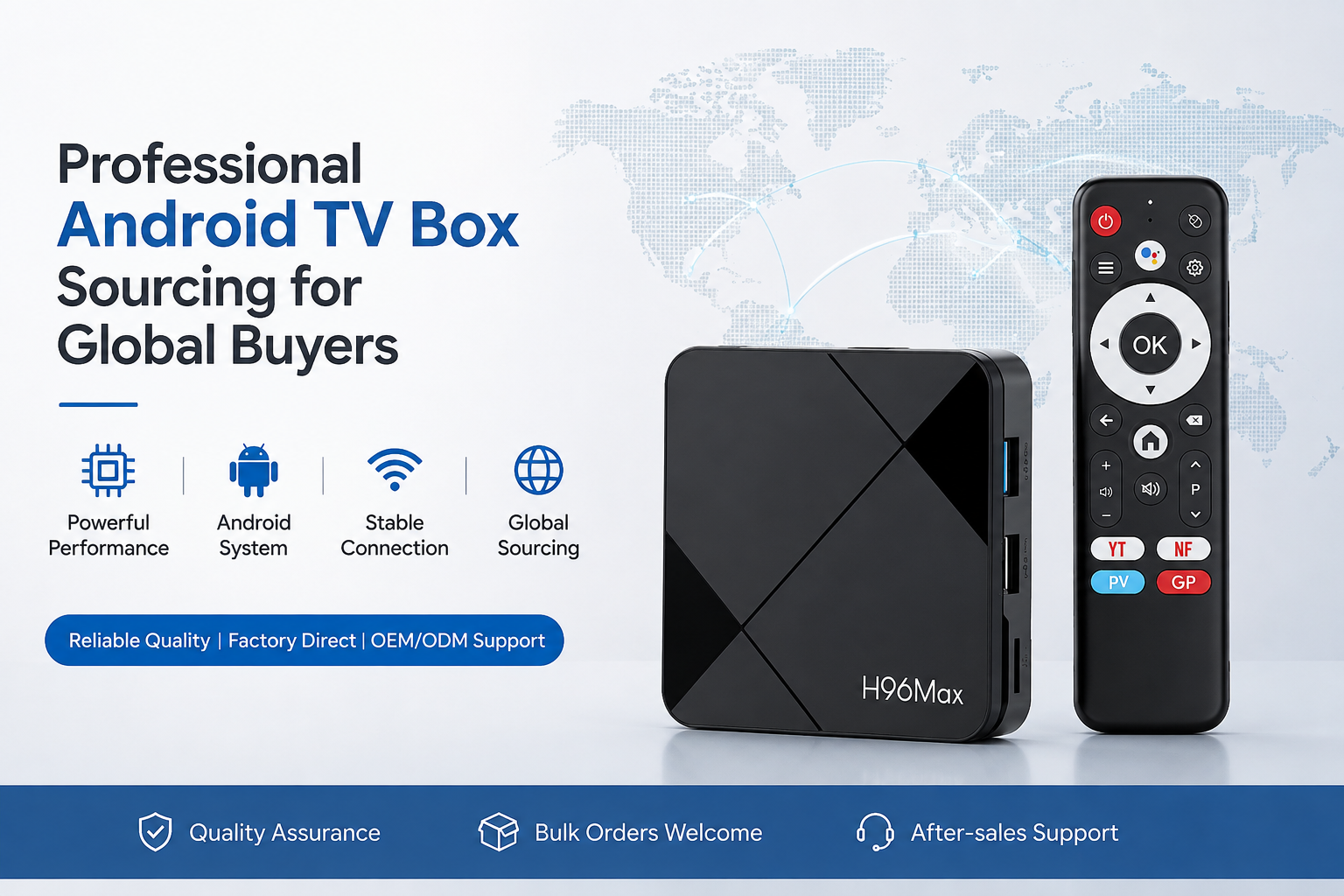
Supplier Fit Beats Spec Sheets: The Questions That Protect Every TV Box Reorder
An Android TV Box Factory decision often goes wrong long before production begins. The buyer compares two spec sheets, sees the same chipset class, memory size, storage, Wi-Fi claim, and 4K wording, then chooses the supplier that sounds fastest or cheapest. The mistake is not in caring about specifications. The mistake is assuming that specifications reveal how the supplier thinks, documents, tests, and supports the product after the first shipment leaves the line.
In a category with real demand, that assumption is expensive. Google has reported that Android TV OS and Google TV reached 220 million monthly active devices, while Grand View Research valued the Android set-top box market at USD 6.9 billion in 2024 and projected steady growth through 2030. Buyers are not sourcing for an empty market; they are sourcing for users who already expect smooth setup, stable apps, reliable remotes, safe firmware, and a box that does not become a support burden after a few weeks.
The first conversation should feel like a diagnosis
A capable Android TV Box Factory does not begin by forcing a catalog model into every opportunity. It asks where the product will be sold, who will install it, which apps matter, how the buyer handles returns, whether the channel needs retail packaging or bulk deployment cartons, and what price band the market can defend. These questions show whether the supplier is planning a product or merely quoting a device.
For a distributor, the answer may be a stable mid-range configuration with better packaging and a clear warranty process. For a hotel integrator, it may be stronger Wi-Fi testing, a simplified launcher, and a reset workflow for staff. For an operator, it may be controlled firmware, remote management readiness, and batch traceability. A supplier that gives one universal answer to all three scenarios is not reducing risk; it is transferring decision work back to the buyer.
A trustworthy quote explains what it protects
Buyers often ask for the lowest Android TV Box Factory Price before defining what the price must protect. A real quote should show the difference between a basic configuration, a safer channel configuration, and a premium or commercial configuration. It should explain adapters, memory grade, Wi-Fi module, enclosure, remote control, packaging, testing time, firmware work, and certificate support. Without that visibility, the buyer cannot know whether the saving comes from efficiency or from removed safeguards.
The right price is the one that supports the sales promise. If the listing promises premium streaming comfort, the product needs enough thermal stability, memory headroom, and remote quality to feel premium. If the product is sold into price-sensitive retail, the design may need to stay conservative, simple, and easy to replace. If the box is part of an operator service, cheap accessories and uncontrolled firmware can create costs far beyond the purchase order. Price is only meaningful when it is connected to use-case risk.
Factory direct should reduce ambiguity, not only cost
The phrase Android TV Box Factory Direct is valuable only when it gives the buyer better access to decisions. Direct sourcing should allow faster clarification of the bill of materials, firmware version, packaging file, QC method, and production schedule. It should also make responsibility visible. Who confirms firmware changes? Who approves accessory substitutions? Who records batch data? Who responds when a field issue appears?
If a supplier says it is direct but cannot provide a locked specification sheet, approved sample reference, production checklist, and version records, the relationship is still risky. The buyer may be speaking to the factory, but not necessarily to a controlled process. Strong direct cooperation turns a vague order into a shared control file that both sides can use when production pressure rises.
OEM work must be judged by repeatability
An Android TV Box OEM Factory is often chosen when the buyer wants a proven model with logo, packaging, boot animation, launcher changes, app preferences, accessory options, and market-specific labels. The project may look simple, but each change creates a repeatability requirement. If the factory cannot reproduce the same firmware, remote behavior, packaging language, and accessory set in the next batch, the buyer’s brand experience becomes inconsistent.
Private-label buyers should keep a golden sample and require the supplier to keep one as well. Before every repeat order, compare a production unit with that reference: boot time, app list, default language, Wi-Fi behavior, remote response, power adapter, HDMI cable, label placement, manual, and carton markings. This is not micromanagement. It is brand protection. Retailers judge the buyer, not the factory, when the second shipment feels different from the first.
ODM value appears when the factory challenges the brief
An Android TV Box ODM Factory should not simply accept every customization request. It should challenge ideas that increase heat, slow firmware, confuse users, complicate production, or create weak claims. A smaller shell may look better but make thermal control harder. A crowded launcher may impress during a presentation but increase support tickets. Too many preloaded apps may reduce first-boot clarity and raise permission concerns.
Good ODM work translates business intent into engineering choices. A retail brand may need a remote that feels better in the hand. A hospitality product may need restricted settings rather than flashy graphics. A commercial signage buyer may need stable reboot behavior and simple recovery more than decorative packaging. The factory’s value is not only in making the requested change; it is in explaining which changes deserve to survive.
Firmware discipline is now part of supplier credibility
A modern Android TV Box Factory must treat firmware as a product layer, not a free attachment. Buyers should ask who owns the build, how versions are named, how apps are preloaded, how permissions are reviewed, how updates are tested, and whether release notes exist. Google’s Play Protect certification guidance emphasizes compatibility, security checks, and protection for certified Android devices. Even when a buyer is sourcing an AOSP-based product, the procurement lesson is clear: software quality must be controlled.
Firmware affects boot speed, app behavior, remote response, standby, Wi-Fi reconnection, OTA strategy, and support diagnosis. A box with strong hardware can still fail commercially if software is inconsistent. If the supplier cannot explain the approved build and how it reaches the production line, the buyer should treat the order as higher risk.
Compliance is becoming a connected-device conversation
For any Android TV Box Factory China project, compliance should be discussed before mass production, not during shipment. The EU Cyber Resilience Act introduced horizontal cybersecurity requirements for products with digital elements, and the FCC created a voluntary cybersecurity labeling program for wireless consumer IoT products. These developments show that connected-device buyers must think beyond electrical safety and basic export documents.
Ask whether CE, FCC, RoHS, wireless module documents, adapter certificates, and any platform-related claims apply to the exact model being shipped. If the adapter changes, if the antenna changes, if firmware claims change, or if preloaded apps change, documentation may need review. A reliable Android TV Box Factory will be honest about what is ready, what requires testing, and what should not be written on packaging or product pages.
One useful interview test is to ask the supplier to explain a past quality issue without naming the customer. The details matter: what failed, how it was detected, how the batch was separated, what changed afterward, and how future orders were protected. A supplier that can discuss failure calmly usually has a process. A supplier that only insists problems never happen is asking the buyer to trust a story instead of evidence.
The strongest partner makes reorders boring
The first order is exciting; the third reorder reveals the partnership. By then, the buyer needs stable components, predictable lead times, clear substitutions, firmware consistency, packaging version control, and support feedback that actually improves the product. A mature Android TV Box Factory will ask about sell-through, return reasons, retailer comments, accessory issues, and user complaints. It will use that information to improve the next batch rather than treating every problem as isolated.
This is where supplier fit becomes more important than a slightly lower unit cost. A factory that keeps the approved sample stable, warns before changes, investigates defects, and documents firmware can help a buyer build a repeatable product line. A factory that only negotiates price forces the buyer to rebuild trust with every shipment.
Choose the factory your customers will never have to think about
The best Android TV Box Factory is not the one your customer praises every day. It is the one your customer never has to think about because setup is clear, playback is stable, the remote works, updates do not surprise them, and support issues are rare. That quiet reliability is created by supplier questions, disciplined documentation, realistic testing, and honest pricing long before the carton reaches the market.
H96 Max supports buyers who need source-factory Android TV box cooperation across OEM branding, ODM development, firmware coordination, packaging, factory-direct communication, pricing discussion, quality control, and bulk production. If your team wants a manufacturing partner that helps protect the first order and every reorder after it, Partner with H96 Max today.
READ MORE
Scaling TV Box Distribution Without Scaling Customer Complaints
From Idea to Launch: Building an ODM Android TV Box That Sells
Factory-Direct Android TV Box Sourcing: What Buyers Must Control
Before You Place a Bulk Order, Audit the Factory Behind the TV Box
Quick Links

.png "Watch H96 Max Android TV Box reviews on our YouTube channel")

.png "Explore H96 Max product photos on Instagram")