.png "H96 Max Android TV Box video reviews and tutorials on YouTube")
.png "H96 Max Android TV Box photos and lifestyle shots on Instagram")



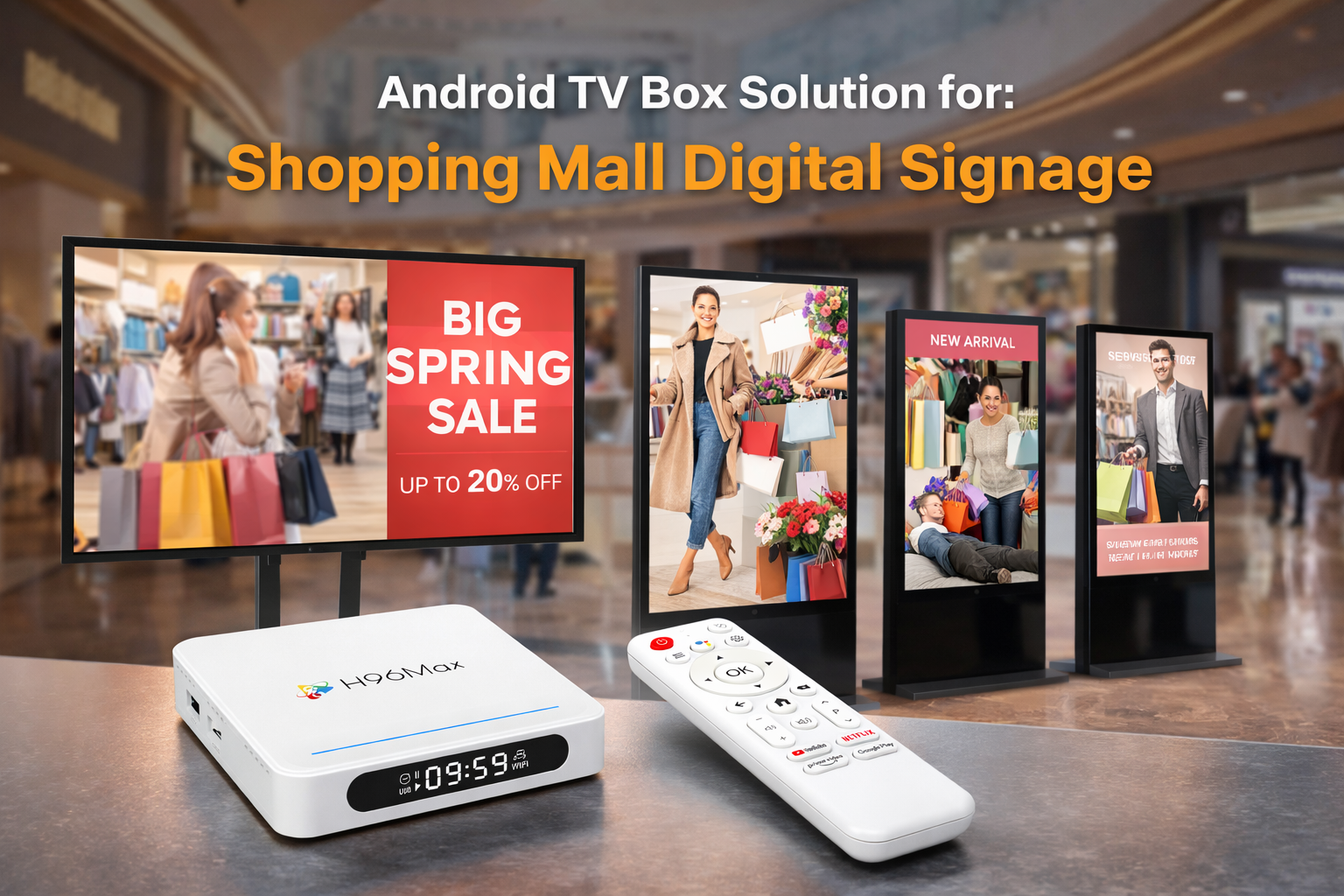
Centralized Mall Advertising Screen Management with Android TV Infrastructure
Modern shopping malls operate dozens or even hundreds of advertising screens distributed across entrances, corridors, elevators, and food courts. Managing such a network manually quickly becomes inefficient and costly. An Android TV Box for Digital Signage has emerged as one of the most practical technologies enabling centralized control of these displays. By connecting screens to a unified software platform, operators can remotely publish campaigns, schedule playback, monitor device health, and maintain the entire advertising network from a single dashboard.
Industry analysts increasingly view Android‑based signage infrastructure as the backbone of scalable retail media networks. According to research from Grand View Research, the global digital
signage market is expected to surpass $45 billion within the next decade, driven largely by retail environments that require flexible and remotely managed display systems. In such environments, a centralized digital signage system using Android TV Box allows operators to maintain consistency across multiple locations without deploying expensive proprietary hardware.
Operational Challenges in Shopping Mall Advertising Networks
Advertising screens inside malls generate significant revenue, but managing them presents several operational challenges. Screens are spread across large areas and multiple floors, and advertising content frequently changes according to campaigns, seasonal promotions, or tenant marketing requirements. Without a centralized management system, updating content would require technicians to physically access each display device.
Manual updates not only increase labor costs but also introduce operational risk. Outdated promotions, inconsistent content schedules, and device downtime directly affect advertising performance. Retail media operators increasingly rely on a dedicated Android TV Box Digital Signage Player to eliminate these inefficiencies. By turning each display into a network‑connected endpoint, content management becomes a centralized process rather than a decentralized maintenance task.
Why Android-Based Systems Offer Strong Cost Efficiency
One of the key reasons mall operators adopt an Android TV Box for Digital Signage is cost efficiency. Compared with proprietary signage hardware, Android platforms benefit from an open ecosystem, large‑scale manufacturing, and flexible software integration. Hardware costs are significantly lower, while the system remains powerful enough to support high‑resolution video, interactive applications, and cloud connectivity.
Market data from IDC highlights that Android devices dominate global smart device shipments due to their scalability and hardware diversity. The same principle applies to digital signage networks. An Android TV Box for Commercial Display can be easily deployed across hundreds of screens while maintaining compatibility with standard content management systems, media players, and cloud infrastructure.
Remote Content Publishing Across Multiple Screens
Remote content distribution is one of the most critical capabilities in modern signage networks. Through a centralized digital signage system using Android TV Box, operators can upload advertising materials once and distribute them instantly to hundreds of screens across a mall. This dramatically reduces operational overhead while ensuring campaign consistency.
For example, when a retailer launches a weekend promotion, the marketing team can deploy updated content across every relevant display within minutes. The Android TV Box for Advertising Display functions as the playback endpoint that retrieves media from the cloud platform and renders it on the connected screen.
This remote publishing capability also allows operators to schedule content in advance. Campaigns can be programmed days or weeks ahead, ensuring that promotional materials appear automatically at the correct time without manual intervention.
Unified Playback Scheduling and Campaign Control
Beyond simple content distribution, centralized scheduling is essential for advertising operations. A mall may run different campaigns for different time slots, locations, or audience segments. Using an Android TV Box Digital Signage Solution, administrators can create complex playback schedules that automatically control which content appears on which screens.
For instance, breakfast promotions can appear on food court screens during morning hours, while fashion campaigns dominate evening foot traffic areas. The scheduling engine ensures that each campaign is delivered according to predefined rules. This capability significantly improves advertising inventory management and maximizes revenue potential.
Real-Time Device Monitoring and System Reliability
Operational reliability is another major concern for mall advertising networks. A single offline screen represents lost advertising impressions and potential revenue loss. To address this issue, modern signage platforms integrate an Android TV Box Remote Management System that continuously monitors device status.
Through centralized monitoring dashboards, operators can check whether each screen is online, verify playback status, and receive alerts when devices encounter errors. Many systems also provide remote troubleshooting capabilities, allowing technicians to restart devices, update software, or adjust configuration settings without visiting the physical location.
This level of visibility significantly improves operational efficiency and reduces downtime across large display networks.
Batch System Updates and Long-Term Maintenance
As signage networks grow, maintaining software consistency across hundreds of devices becomes increasingly complex. Android infrastructure simplifies this process by enabling batch firmware updates and remote system maintenance. With an Android TV Box for Digital Signage, administrators can deploy updates across the entire device fleet simultaneously.
This ensures that all media players operate on the same software version, improving security and system stability. Remote update capabilities also allow operators to roll out new features or compatibility improvements without replacing hardware. From a lifecycle perspective, this dramatically lowers long‑term operational costs.
Industry Validation and Market Adoption
The adoption of Android‑based signage infrastructure is supported by strong industry trends. Media technology reports from companies such as Statista and MarketsandMarkets highlight the rapid growth of retail media networks powered by connected display devices. Analysts emphasize that flexible hardware platforms are essential for scaling digital advertising ecosystems.
Within this ecosystem, the Android TV Box for Digital Signage serves as the bridge between display hardware and cloud content management platforms. Its ability to integrate with widely used CMS software, streaming protocols, and advertising analytics tools makes it particularly attractive for commercial display environments.
Understanding How Centralized Android Signage Works
Many operators exploring digital signage infrastructure often ask how to manage digital signage screens with Android TV Box. The basic architecture involves three layers: display hardware, Android media players, and a centralized cloud management platform. Each screen is connected to an Android device that handles media decoding and network communication.
The central management platform controls content distribution, scheduling, and monitoring. Administrators interact with this platform through a web dashboard, allowing them to manage the entire advertising network remotely. This architecture allows mall operators to scale from a few screens to hundreds or even thousands without significantly increasing operational complexity.
Why Retail Media Networks Prefer Android Signage Infrastructure
Retail environments demand systems that are flexible, scalable, and economically sustainable. The Android TV Box for Digital Signage satisfies these requirements by combining low hardware costs with strong performance and broad software compatibility. As advertising networks expand, operators benefit from the ability to add new screens quickly without redesigning their infrastructure.
This scalability has made Android‑based signage solutions particularly attractive for malls, airports, transportation hubs, and commercial complexes. By leveraging cloud connectivity and remote management tools, operators can transform traditional display screens into dynamic advertising platforms capable of delivering targeted campaigns in real time.
Conclusion
For shopping mall advertising operators, centralized control is no longer optional—it is essential for maintaining operational efficiency and maximizing advertising revenue. Technologies such as remote publishing, unified scheduling, device monitoring, and batch system updates are critical components of a modern signage infrastructure.
The growing adoption of Android‑based signage platforms demonstrates that flexible, scalable, and cost‑efficient technologies are shaping the future of commercial display networks. Organizations seeking to build or expand retail media infrastructure increasingly rely on Android‑powered devices to simplify operations and enable large‑scale display management.
For companies exploring reliable manufacturing partners for such infrastructure, collaborating with experienced device manufacturers can provide additional advantages in customization, scalability, and long‑term supply stability. Partner with H96 Max today to explore how Android media devices can support the next generation of digital signage networks.
READ MORE
How Content Platforms Can Launch Subscription Services Through Android TV Boxes?
How to Build a Digital Signage System Using an Android TV Box?
How Can Schools Use Android TV Boxes for Campus Television Networks?
How Sports Bars Deliver Streaming Entertainment with Android TV Boxes?
How Can Airports Build an Information Display System Using Android TV Boxes?
How to Build a Community TV Network Using an Android TV Box?
How Smart Home Platforms Use Android TV Boxes to Build a Home Entertainment Center?
Quick Links

.png "Watch H96 Max Android TV Box reviews on our YouTube channel")

.png "Explore H96 Max product photos on Instagram")