.png "H96 Max Android TV Box video reviews and tutorials on YouTube")
.png "H96 Max Android TV Box photos and lifestyle shots on Instagram")



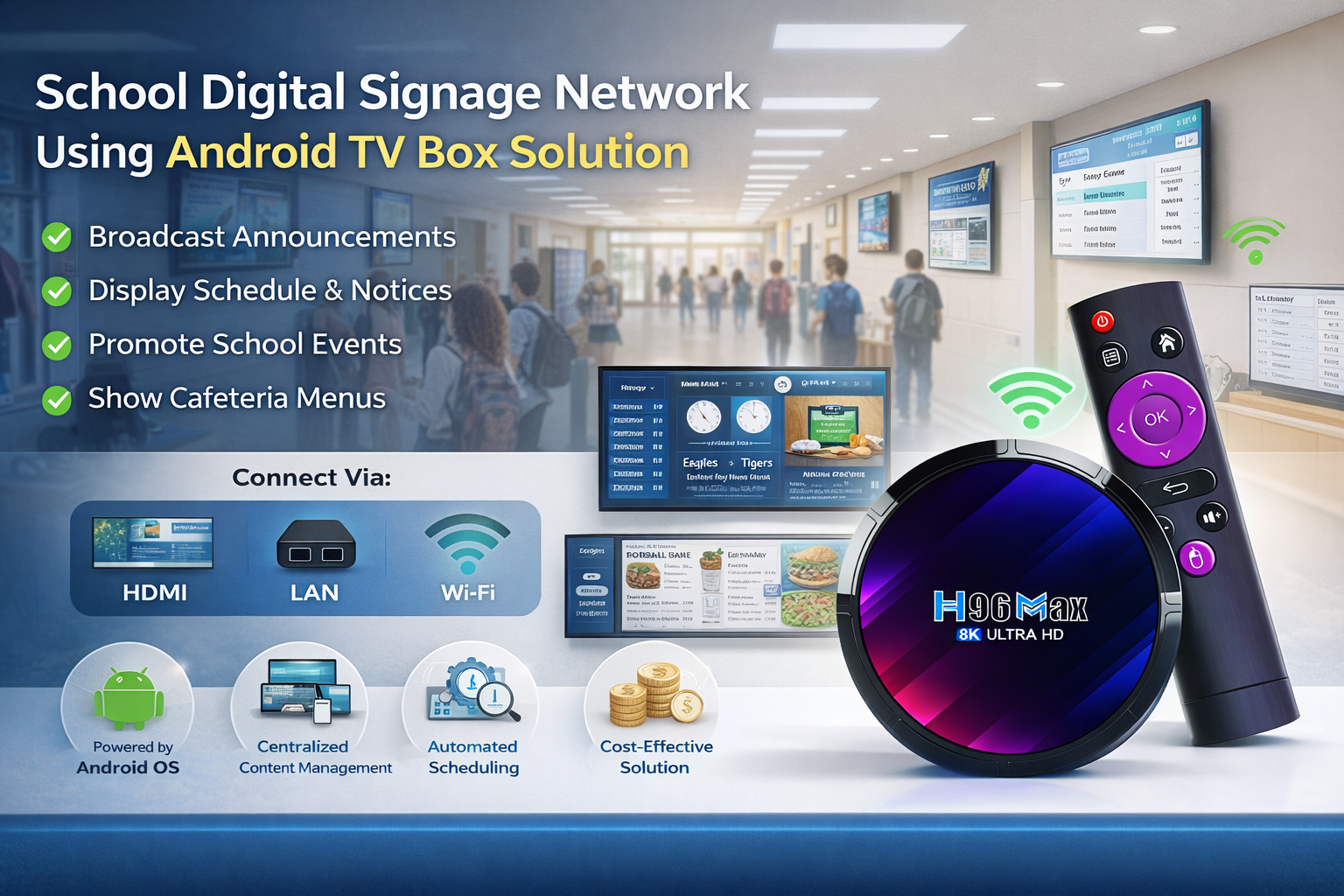
How Schools Can Build Modern Campus TV Networks with Android TV Boxes
Across modern education systems, digital communication has become a critical component of campus operations. An Android TV Box for School IPTV System is increasingly being adopted as the terminal device that connects classrooms, dormitories, cafeterias, and administrative buildings to a unified campus television network. Schools are no longer relying solely on traditional cable broadcasting or scattered display solutions. Instead, educational institutions are building integrated IPTV ecosystems that deliver announcements, live broadcasts, recorded lectures, emergency messages, and multimedia learning content to every screen on campus.
Educational technology analysts frequently highlight that campus communication efficiency directly affects learning engagement and operational transparency. According to several global education technology reports, over 70% of universities are expanding digital signage and IPTV infrastructures to improve information delivery and multimedia teaching. Within this transformation, the Android‑based terminal device has emerged as a flexible and scalable endpoint for campus networks.
The Growing Demand for Unified Campus Media Systems
Modern schools operate complex communication environments. Administrators must share announcements quickly, teachers increasingly rely on multimedia content, and students expect dynamic digital information displays. Traditional broadcast equipment is often expensive, hardware‑locked, and difficult to scale across large campuses. This is where solutions such as an Android TV Box for School TV System provide a practical alternative.
A campus television infrastructure typically needs to distribute several types of content simultaneously: administrative notices, live campus events, lecture recordings, emergency alerts, and educational programming. An Android‑based IPTV endpoint can support all of these formats through software platforms rather than proprietary broadcasting hardware.
Technology researchers at HolonIQ and EdTech Magazine note that educational institutions are prioritizing flexible digital infrastructure capable of supporting both communication and instruction. Android‑based terminals align well with these priorities because they integrate easily with existing IP networks and cloud‑based media systems.
Multimedia Learning Delivery Across the Entire Campus
One of the primary advantages of deploying an Android TV Box for Campus IPTV System is the ability to deliver multimedia learning resources directly to screens across classrooms and common areas. Teachers today increasingly use recorded lectures, educational documentaries, digital whiteboard sessions, and online course platforms.
Instead of requiring individual devices in every classroom, a centralized IPTV network allows educational media to be streamed directly through campus displays. With the Android ecosystem supporting common media codecs and streaming protocols, these terminals can handle high‑definition educational content without specialized broadcast hardware.
In many institutions, IPTV systems are also used to distribute live academic seminars or guest lectures to multiple lecture halls simultaneously. This transforms the campus television infrastructure into a shared educational resource rather than simply a display system.
Centralized Management for Large Educational Institutions
Another major reason schools adopt Android terminals is centralized device management. A campus network may contain hundreds or even thousands of displays. Without unified management tools, maintaining such infrastructure becomes extremely difficult.
Through device management platforms, an Android TV Box for Educational TV Network can be remotely configured, updated, and monitored. Administrators can schedule content, update applications, reboot devices, or deploy security patches from a single dashboard.
Industry research by Gartner consistently highlights centralized device control as one of the key requirements for enterprise digital display systems. Educational institutions face similar scalability challenges as corporate networks, making centralized management a crucial capability.
Campus Announcements and Information Broadcasting
School communication extends beyond classroom teaching. Daily campus operations require continuous information distribution. Displays in corridors, cafeterias, libraries, and student centers often broadcast schedules, event announcements, safety notifications, and campus news.
In these scenarios, an Android TV Box for Digital Signage in Schools acts as the media player that powers each display. Administrators can schedule visual announcements, rotating banners, and informational videos through a centralized content management platform.
Digital signage networks in educational institutions have been widely studied. According to several university IT reports, digital signage systems significantly improve student awareness of campus events and services when compared with traditional printed notice boards.
Low‑Cost Infrastructure for Large‑Scale Deployment
Budget efficiency is one of the most important considerations for schools when building new technology systems. Proprietary broadcast equipment can be extremely expensive, particularly when scaled across multiple buildings.
An Android TV Box for Campus Broadcasting System offers a cost‑effective alternative because it uses standard consumer‑grade hardware combined with open software ecosystems. This dramatically reduces both initial hardware investment and long‑term maintenance costs.
Educational procurement reports often emphasize the importance of scalable technologies that can be deployed incrementally. Android‑based IPTV terminals allow institutions to expand their campus television networks gradually without major infrastructure replacement.
Flexibility of the Android Ecosystem
Another key advantage is the flexibility of the Android operating system itself. Unlike proprietary set‑top boxes, Android platforms support a wide range of media applications, IPTV middleware solutions, and custom software platforms.
This flexibility is particularly useful for universities and technical schools that may want to develop their own campus media applications. An Android device allows IT departments to deploy custom apps designed for school announcements, course broadcasting, or campus event streaming.
The open nature of Android also ensures long‑term compatibility with emerging media technologies and streaming protocols.
Scalable Architecture for Future Digital Campuses
As campuses continue to evolve into digital learning environments, communication infrastructure must be able to scale alongside institutional growth. IPTV networks powered by Android endpoints can expand easily across new buildings, departments, or remote learning centers.
For administrators researching How to build a school IPTV system using Android TV Box, the typical architecture involves a centralized content server, IPTV middleware platform, network distribution layer, and Android‑based display terminals.
When properly designed, such systems allow content to be distributed simultaneously to hundreds of screens with minimal bandwidth overhead. Universities in Europe and Asia have already implemented campus IPTV networks that support lecture broadcasting, event streaming, and information displays across entire campuses.
Selecting the Right Terminal for Campus Broadcasting
Institutions evaluating the Best Android TV Box for school campus TV broadcasting often focus on several key criteria: stable hardware performance, long‑term software support, network reliability, and compatibility with IPTV middleware platforms.
Education technology specialists also recommend choosing devices capable of supporting centralized device management and remote firmware updates. These features significantly reduce maintenance workload for campus IT teams.
Ultimately, the value of Android‑based IPTV terminals lies in their ability to combine flexibility, scalability, and cost efficiency within a single device.
Conclusion
The modernization of campus communication systems is reshaping how schools share information, deliver educational media, and manage digital infrastructure. From classroom learning to campus‑wide announcements, IPTV networks are becoming an essential part of the digital campus ecosystem.
By integrating multimedia playback capabilities, centralized device management, scalable deployment models, and open software ecosystems, Android‑based terminals provide an effective foundation for modern educational broadcasting systems.
For institutions exploring the future of campus television networks, Android IPTV terminals represent a practical and forward‑looking approach. Organizations seeking reliable hardware partners for large‑scale deployments may consider collaborating with experienced manufacturers. Partner with H96 Max today to explore cooperation opportunities in building next‑generation campus IPTV infrastructure.
READ MORE
How Content Platforms Can Launch Subscription Services Through Android TV Boxes?
How to Build a Digital Signage System Using an Android TV Box?
How Sports Bars Deliver Streaming Entertainment with Android TV Boxes?
How Mall Advertising Screen Systems Achieve Centralized Management with Android TV Boxes?
How Can Airports Build an Information Display System Using Android TV Boxes?
How to Build a Community TV Network Using an Android TV Box?
How Smart Home Platforms Use Android TV Boxes to Build a Home Entertainment Center?
Quick Links

.png "Watch H96 Max Android TV Box reviews on our YouTube channel")

.png "Explore H96 Max product photos on Instagram")